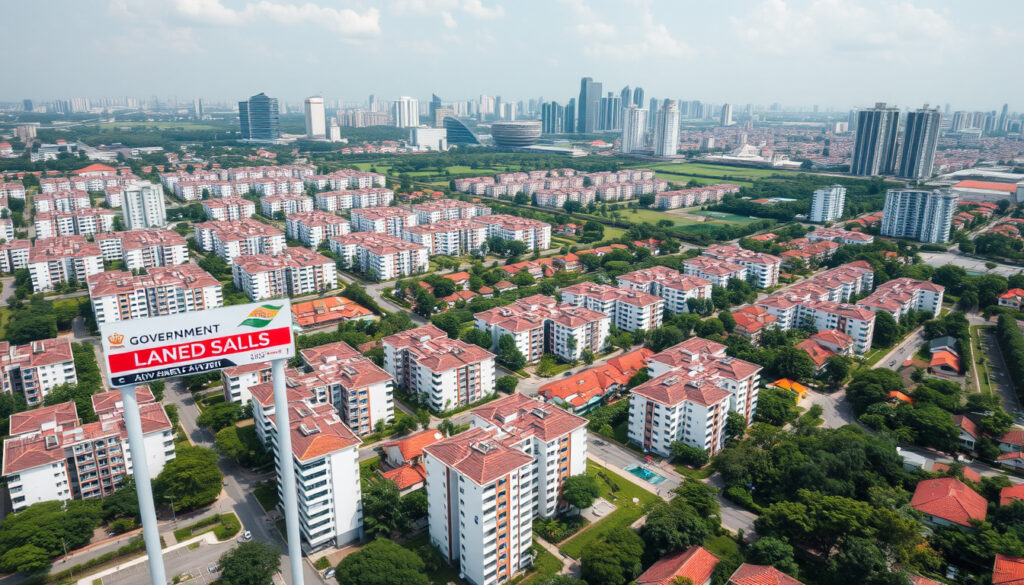
URA HDB Singapore Land Sales: Government Land Sales Guide
If you’ve ever wondered who really owns the land beneath your HDB flat or the private condo you’re eyeing, the answer is bolder than most expect: the Singapore government, through a tightly coordinated programme called the Government Land Sales (GLS), which decides which parcels go to market, who can bid, and what happens when the 99-year clock runs out. This guide walks through the agencies that run it, the rules that govern it, and what it all means for buyers and investors.
State land ownership in Singapore: ~90% owned by the state ·
HDB residents: Over 80% of resident households live in HDB flats ·
Typical HDB lease: 99 years ·
GLS sites offered (2H 2026): 9 confirmed sites by URA ·
Land sales agent involvement: SLA appoints URA, HDB, and JTC
Quick snapshot
- State owns ~90% (gov.sg explainer (Singapore government))
- SLA manages state land (URA Land Sales (urban planning authority))
- URA, HDB, JTC are agents under GLS (URA Land Sales)
- Tenders for private and public housing (HDB Government Land Sales (public housing authority))
- Government Land Sales programme (URA Land Sales)
- Confirmed List and Reserve List (The Business Times (Singapore property news))
- Singaporeans can buy most types
- Foreigners restricted on landed property and HDB
The state controls nearly every aspect of land supply and tenure.
| Fact | Value |
|---|---|
| Land ownership | ~90% state-owned (gov.sg explainer) |
| HDB residents | Over 80% of households (gov.sg explainer) |
| Lease term new HDB | 99 years (gov.sg explainer) |
| GLS agent agencies | URA, HDB, JTC (appointed by SLA) (URA Land Sales) |
| 2H 2026 GLS Confirmed List supply | 9 sites, ~9,200 private residential units including ECs (The Business Times) |
| Full-year 2026 Confirmed List supply | 9,320 units, 50%+ above 10-year average (URA media release PR26-41) |
| Total pipeline supply (private + EC) | ~61,000 units (URA media release PR26-41) |
| Inventory available for sale in next 2 years | ~32,000 units (URA media release PR26-41) |
Who owns most of the land in Singapore?
State land vs. freehold land
Since independence in 1965, the Singapore government has taken a dominant role in land ownership. Roughly 90% of all land is held by the state, with freehold land representing only a small fraction — mostly in older developments and a few historic properties. The gov.sg explainer (Singapore government) confirms that since 1967, all sites sold for private residential use have been released on leases no longer than 99 years. This means almost no new freehold land enters the market.
Role of the Singapore Land Authority (SLA)
The SLA is the statutory board that manages state land. It does not sell land directly to developers; instead, it appoints land sales agents. According to the Singapore Land Authority (SLA) – official site, “SLA appoints URA, HDB and JTC as our Land Sales Agents for the sale of State lands under the Government Land Sales (GLS) and Industrial Government Land Sales (IGLS) programmes.” This delegation is the engine that drives land supply for both public housing and private developments.
Because the state owns nearly all land, developers and homebuyers are essentially leasing from a single landlord — the government. The terms of that lease, particularly the 99-year clock, shape property values and investment decisions far more than in any other developed market.
The implication: the state’s control over land ownership centralizes leverage over the entire property market.
Is URA under HDB?
URA’s role in land sales
The Urban Redevelopment Authority (URA) is Singapore’s national land-use planning authority. It is a separate statutory board from HDB, though both sit under the Ministry of National Development. URA manages the GLS programme for private residential, commercial, and mixed-use sites. Its Land Sales portal is the central hub for tender schedules, site availability, and programme announcements. URA also publishes the media release PR26-38 detailing the 2H 2026 GLS programme, which includes nine Confirmed List sites and thirteen Reserve List sites.
HDB’s role in land sales
The Housing and Development Board (HDB) focuses on public housing. It sells land for the construction of HDB flats and Executive Condominiums (ECs) through its own GLS track. The HDB Government Land Sales page lists upcoming EC sites such as Canberra Drive (estimated launch May 2026) and Sembawang Drive (estimated launch June 2026).
How URA and HDB coordinate under GLS
Both agencies are appointed as land sales agents by SLA. Their roles are complementary: URA handles the bulk of private residential and commercial land, while HDB manages land for public housing and ECs. The GLS programme is announced twice a year, with a Confirmed List (sites that will be tendered during the period) and a Reserve List (sites that developers can trigger by applying). The URA media release PR26-41 states that the full-year 2026 Confirmed List supply will be 9,320 units, more than 50% higher than the annual average over the past decade.
The separation of URA and HDB means that a buyer looking at a private condo and a buyer queuing for a BTO flat are dealing with different agencies, different tender processes, and different lease structures — but the land ultimately comes from the same state pool. The coordination ensures that supply is balanced across market segments.
What does GLS mean in Singapore property?
Government Land Sales (GLS) programme explained
GLS stands for the Government Land Sales programme, the mechanism by which the Singapore government releases state land for development. It is a supply-side tool that directly influences private housing prices, rental markets, and the pace of urban development. The URA Land Sales portal describes it as the “primary channel for the sale of State land for private residential, commercial, hotel, and industrial use.”
Confirmed List vs. Reserve List
Each GLS programme period (usually half a year) includes two lists. The Confirmed List contains sites that URA commits to tendering within the period. The Reserve List contains sites that will be put up for tender only if a developer submits an application with a minimum bid price acceptable to the government. The Business Times reported that the 2H 2026 GLS programme includes nine Confirmed List sites and thirteen Reserve List sites, expected to yield about 9,200 private residential units including ECs.
The implication: the Confirmed List guarantees a baseline supply, while the Reserve List lets the market signal demand. This dual structure prevents over-supply while keeping the state in control of timing.
Is it possible to buy land in Singapore?
Buying land from GLS tenders
Yes, but only through the GLS tender process. Developers, not individuals, typically bid for sites. The tender process is open to registered applicants, and the highest compliant bid wins. For example, the URA media release PR26-38 announced the launch of two sale sites in late July 2026: Berlayar Drive (tender closes 4 August 2026) and New Upper Changi Road (tender closes 1 September 2026).
Restrictions for foreigners
Foreigners face significant restrictions on land ownership in Singapore. They cannot purchase landed property (e.g., detached houses, semi-detached houses, bungalows) without government approval, and they are generally not allowed to buy HDB flats. However, they can buy private condominiums and apartments. The gov.sg explainer makes clear that the 99-year lease policy applies to all private residential land sold since 1967, so even foreigners buying private condos are on a leasehold tenure.
Leasehold vs. freehold land
Almost all land transacted through GLS is leasehold, typically 99 years. Freehold land is rare and usually inherited from pre-1965 developments. The URA’s Current GLS Sites page (last updated 3 July 2026) lists sites such as Chuan Grove and Plymouth Avenue/Dunearn Road with a status of Oct-2026, all leasehold. For a buyer, the difference is critical: leasehold value declines as the lease shortens, while freehold land retains its value indefinitely.
For a Singaporean buyer, the ability to purchase a 99-year leasehold condo from a GLS developer is the most common path to homeownership. For a foreigner, the same path exists but with a higher tax burden (Additional Buyer’s Stamp Duty) and a total ban on landed property. The leasehold structure means that every home is a depreciating asset over the long term — unless the government intervenes with a lease renewal or collective sale.
What happens to landed property after 99 years in Singapore?
Lease expiry options
When a 99-year lease on a private residential building expires, ownership of the land reverts to the state. The building itself may be demolished or acquired by the government. There is no automatic right to renew. The gov.sg explainer states that “since 1967, all sites for private residential land in Singapore have also been sold on leases no longer than 99 years.” This means that the entire post-1967 private housing stock is on a ticking clock.
HDB lease expiry process
HDB flats are sold on 99-year leases, and the same rule applies: when the lease ends, the land returns to the state. HDB has a Lease Buyback Scheme and other options for older flats, but the fundamental principle is that the flat’s value depreciates toward zero as the lease shortens. The HDB Government Land Sales page confirms that all new EC and HDB sites are 99-year leasehold.
Private landed lease expiry
For private landed properties (e.g., landed houses on 99-year leases), the same expiry mechanism applies. Owners cannot renew the lease individually; the land is returned to the state. In practice, the government may grant a collective sale or redevelopment, but there is no guarantee. The only way to own the land outright is to hold a freehold title, which is virtually impossible to acquire through GLS.
The pattern: every leasehold owner — whether in a HDB flat, EC, or private condo — faces the same endgame. The value of the property is a function of the remaining lease term, and the state retains the ultimate asset.
How to participate in a GLS tender
If you’re a developer or an investor looking to bid on a GLS site, the process is straightforward but requires preparation. Here are the steps:
- Monitor the URA Land Sales portal for the latest GLS programme announcements. The 2H 2026 programme was released on 3 June 2026.
- Review the Confirmed List and Reserve List. For the Confirmed List, tenders run on a fixed schedule. For the Reserve List, submit an application to trigger a tender.
- Prepare the required documents: tender deposit, financial statements, and development proposal. The specific requirements are listed on the URA website.
- Submit your bid before the tender closing date. For example, the Berlayar Drive site tender closes on 4 August 2026 at 12 noon.
- Wait for the tender results. The highest compliant bid wins, and the site is awarded.
For individual homebuyers, the process is different: you don’t bid on land; you buy a unit from a developer who has won a GLS tender. The key is to understand the leasehold tenure and the remaining lease term.
Timeline: Singapore land sales milestones
- 1965 – Singapore’s independence, state land ownership framework established.
- 1960s–1990s – Expansion of HDB public housing program, mass land acquisition (gov.sg explainer).
- 2H 2026 – URA offers nine Confirmed List sites under GLS programme, with tenders closing in August and September 2026 (URA media release PR26-38).
Confirmed facts and what’s unclear
Confirmed facts
- State owns ~90% of land in Singapore.
- URA is a separate agency from HDB, both under Ministry of National Development.
- GLS means Government Land Sales.
- All residential land sold since 1967 is on 99-year leases.
What’s unclear
- Whether specific future GLS sites will be placed on Confirmed or Reserve List before official publication.
- The exact breakdown of land ownership percentage by agency is not publicly detailed.
Quotes on land sales
“Currently, SLA appoints URA, HDB and JTC as our Land Sales Agents for the sale of State lands under the Government Land Sales (GLS) and Industrial Government Land Sales (IGLS) programmes.”
Singapore Land Authority (SLA) – official site
“The full-year GLS Confirmed List supply for 2026 will be 9,320 units, more than 50% higher than the annual average Confirmed List supply over the past 10 years.”
URA media release PR26-41
Summary
The Government Land Sales programme is the cornerstone of Singapore’s land policy, giving the state near-total control over land supply, tenure, and pricing. For homebuyers, the 99-year leasehold system means that every property is a depreciating asset unless the government steps in. For a Singaporean family looking to buy a home, the choice is clear: understand the remaining lease term and plan for the end of the lease, or accept that the land will eventually return to the state. For foreigners, the restrictions on landed property and HDB mean that private condos are the only option — and they come with the same leasehold clock.
ura.gov.sg, hdb.gov.sg, ura.gov.sg, launches.sg, propkaki.sg, era.com.sg, ura.gov.sg, channelnewsasia.com
Frequently asked questions
What is a Confirmed List in GLS?
The Confirmed List contains sites that the government commits to tendering during a specific GLS programme period. These sites are put up for sale on a fixed schedule, and developers can bid on them.
What is a Reserve List in GLS?
The Reserve List includes sites that will be put up for tender only if a developer submits an application with a minimum bid price acceptable to the government. This allows the market to signal demand.
Can a foreigner buy a HDB flat?
Generally, no. HDB flats are reserved for Singapore citizens and permanent residents. Foreigners can only purchase HDB flats under specific conditions, such as if they are a permanent resident and meet certain eligibility criteria, but the rules are strict.
What documents are required for a URA land tender?
Developers need to submit a tender deposit (usually 5% of the bid price), financial statements, company registration documents, and a development proposal. The exact requirements are listed on the URA Land Sales portal.
How often are URA land sales held?
URA releases GLS programmes twice a year, typically in June and December. Each programme covers a six-month period, with confirmed tenders scheduled throughout the period.
What happens to my HDB flat after 99 years?
The land lease expires and the flat reverts to the state. HDB offers schemes like the Lease Buyback Scheme to help elderly owners monetise their flats, but the property itself loses value as the lease shortens.
Can I buy freehold land in Singapore?
Freehold land is extremely rare and almost never sold through GLS. Most freehold properties are inherited from pre-1965 developments. The government has not sold freehold land for residential use for decades.
Related reading: West Hill @ Bukit Batok BTO Guide: 962 Units & Tour · Singapore Home Sizes Decrease: Why Houses Are Getting Smaller
More related posts
 Cedar Girls’ Secondary School: History, Motto & Affiliation
 Singapore COE Prices Rise: Latest Results and Renewal Impact
 Food at Dhoby Ghaut: Best Cheap Eats & Halal Options
 Blue Jays vs Dodgers: Game 7 World Series Odds & Analysis
 How to Repost Instagram Stories: Tagged, Not Tagged & Fixes
 Convert PDF to PNG: Best Free Converters for Any Device
 West Coast GRC 2020 – Singapore Constituency, Not Conference
