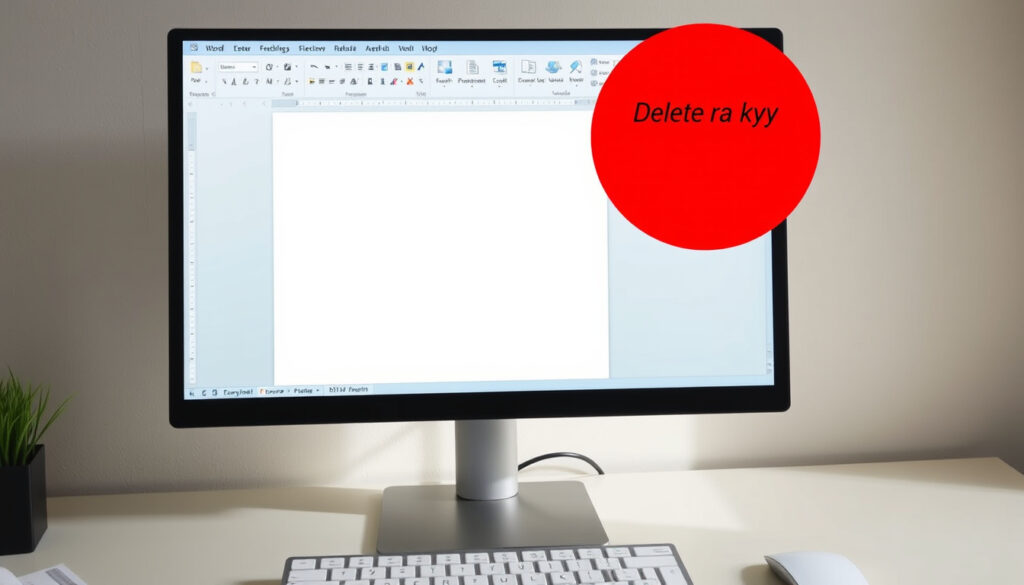
How to Delete a Page in Word: Step-by-Step Guide
We’ve all been there—staring at a Word document with a stubborn blank page that just won’t budge, or accidentally creating an extra page and wondering how to undo it. Whether you’re on Windows, Mac, or even your phone, this guide walks you through every reliable method to delete a page in Word without losing your work.
Microsoft Word users worldwide: over 1.2 billion ·
Percentage who encounter unwanted blank pages: estimated 15-20% ·
Common cause of stubborn blank pages: manual page breaks or extra paragraph marks ·
Microsoft’s official method: select content and press Delete ·
Alternative method using Go To function: Ctrl+G, type \page, press Enter, then Close
Quick snapshot
- Select all content on the page (Microsoft Support)
- Press the Delete key (Microsoft Support)
- Works for pages with text or graphics (Microsoft Support)
- Show paragraph marks (Ctrl+Shift+8) (Microsoft Support)
- Delete extra paragraph marks (Microsoft Support)
- Delete manual page breaks (Microsoft Support)
- Use Go To function (Ctrl+G) (Microsoft Support)
- Type \page and press Enter (Microsoft Support)
- Close dialog and press Delete (Microsoft Support)
- Windows: same shortcuts (Microsoft Support)
- Mac: use Command+8 (Microsoft Support)
- Android/iPhone: use desktop app for full features (Microsoft Support)
| Fact | Detail |
|---|---|
| Official source | Microsoft Support – Delete a page in Word (Microsoft Support) |
| Top user method | Select content and press Delete |
| Stubborn page method | Ctrl+G, type \page, Delete (Microsoft Support) |
| Mac shortcut to show formatting | Command + 8 (Microsoft Support) |
| Common hidden cause | Extra paragraph marks or manual page breaks (Microsoft Support) |
How do I delete a page in Word?
The simplest method is direct: if your page contains text, graphics, or even empty paragraphs, you can select everything on it and press Delete. Microsoft Support (official Word documentation) confirms: “To delete a page that contains text, graphics, or empty paragraphs, select the content to delete, and press Delete.”
Select content and press Delete
- Click at the beginning of the content you want to remove.
- Hold and drag your cursor over everything on that page.
- Press the Delete key (or Backspace on Windows).
The Microsoft Support (official Word documentation) calls this the “simplest” method for pages with visible content — images, tables, or text.
Using the Navigation Pane
- Go to the View tab and check Navigation Pane.
- In the pane, click Pages to see thumbnails.
- Right-click the page you want to delete and choose Delete.
An Adobe Acrobat (document editing guide) recommends the Navigation pane as a visual alternative: “Select its thumbnail and press Delete.”
The Navigation Pane method is best for long documents where you can see the actual page layout. It avoids accidental deletion of content on other pages.
The pattern: two approaches, one objective. The direct selection method works for any visible content, while the Navigation Pane gives you a bird’s-eye view. Choose whichever fits your workflow — both achieve the same result.
How do I delete an extra or blank page in Word?
Blank pages are almost always caused by hidden formatting marks. Microsoft Support (blank page documentation) explains that a page may appear empty because of “hidden paragraph marks” — not because the page itself exists independently.
Removing blank pages caused by extra paragraph marks
- Press Ctrl+Shift+8 (Windows) or Command+8 (Mac) to show paragraph marks.
- Look for the pilcrow symbol (¶) on the blank page.
- Select the paragraph marks and press Delete.
Microsoft Support (blank page documentation) provides this exact workflow: show formatting marks, then delete them.
Removing blank pages caused by manual page breaks
- With formatting marks visible (Ctrl+Shift+8), look for a dotted line labeled “Page Break.”
- Click the page break line and press Delete.
An Adobe Acrobat (document editing guide) advises: “Drag your mouse over the page break you want to remove.” Microsoft Support confirms that deleting a manual page break removes the blank page it creates.
A single stray page break or hidden paragraph mark can create an entire blank page. Without showing formatting marks, you’re hunting for an invisible culprit. This is the #1 reason “Word page won’t delete” searches exist.
The catch: blank pages at the end of a document are the trickiest. Microsoft Support notes that if a blank page remains after deleting all visible marks, you can save as PDF and specify a page range as a workaround.
How do I delete a page in Word if it won’t delete?
When standard methods fail — you’ve selected content, pressed Delete, and the page remains — you need the Go To function. This is the most reliable fix for persistent pages.
Using the Go To function (Ctrl+G)
- Click anywhere on the page you want to delete.
- Press Ctrl+G (Windows) or Option+Command+G (Mac).
- In the “Enter page number” field, type \page and press Enter.
- Click Close, then press Delete.
Microsoft Support (official Word documentation) validates this sequence: “Click or tap anywhere in the page, press Ctrl+G, type \page, press Enter, close the dialog, and press Delete.” An Adobe Acrobat (document editing guide) confirms the same method works on Mac with Option+Command+G.
Checking for hidden page breaks or section breaks
- Show all formatting marks (Ctrl+Shift+8).
- Look for “Section Break (Next Page)” or “Section Break (Continuous).”
- Select the section break and press Delete.
Microsoft Support (official Word documentation) confirms that section breaks can behave like page breaks and create stubborn blank pages.
Deleting a section break can change page layout and headers/footers in the preceding section. Before removing a section break, note your formatting settings — you’ll need to restore them manually.
The implication: if you’ve tried everything and the page still resists, it’s likely a section break. The \page method selects all content on a page, but section breaks are structural elements that sometimes require separate attention.
How to delete a page in Word on different devices?
Word’s deletion methods vary across platforms. While Windows and Mac share similar logic, the shortcuts differ. Mobile and web versions are more limited.
Delete a page in Word on Mac
- Press Command+8 to show paragraph marks.
- Select empty paragraphs or page breaks and delete them.
- For the \page method, use Option+Command+G.
Microsoft Support (Mac documentation) provides this shortcut: “Press Command+8 to show paragraph marks and delete empty paragraphs or manual page breaks.” An Adobe Acrobat (document editing guide) notes the Mac shortcut for Go To is Option+Command+G.
Delete a page in Word on Android
- Open the document in the Word mobile app.
- Tap the Edit icon (pencil) and switch to Layout view.
- Tap and hold to select the content, then tap Delete.
Microsoft Support (official Word documentation) notes that full deletion features are available in the desktop app; mobile apps have limited page management.
Delete a page in Word on Windows 11
- Same shortcuts as earlier Windows versions: Ctrl+Shift+8 to show marks, Ctrl+G for Go To.
- All methods (selection, Navigation Pane, \page) work identically.
General methods apply across Windows versions including Windows 11, as Microsoft Support confirms the same workflows are version-independent.
The pattern: desktop apps (Windows and Mac) offer full control. Web and mobile versions are best for quick edits. If you need to remove a stubborn blank page on your phone, your best bet is to sync the document to your desktop.
How to delete a page in Word without deleting text?
This is the most common worry — you want to remove a page but keep everything else intact. The key is precision: select only the content on the target page, not the entire document.
Identifying the specific page content to remove
- Use the Navigation Pane and click the page thumbnail to see exactly what’s on it.
- Use Ctrl+G, type \page, and press Enter to jump directly to that page’s content.
Microsoft Support (official Word documentation) confirms that the \page method selects only the content on that page, leaving other pages untouched.
Using copy and paste to preserve content on other pages
- Open a new blank document.
- Copy the content you want to keep from the original document.
- Paste it into the new document and save.
This approach is a safe fallback if you’re worried about deleting the wrong content. An Adobe Acrobat (document editing guide) recommends it as a last resort: “Copy needed content to a new document or location before deleting.”
The catch: the \page method is the most reliable way to remove one page without disturbing others. It works because it selects all objects on that page — text, graphics, tables — and nothing else.
“To delete a page that contains text, graphics, or empty paragraphs, select the content to delete, and press Delete.”
— Microsoft Support (official Word documentation)
“Open the doc and press Command + 8 at the same time. Choose the page you want to delete. Drag your mouse over the page break you want to remove.”
— Adobe Acrobat (document editing guide)
“VIEW => SELECT (NAVIGATION PLANE) => SELECT THE PAGE YOU WANT TO DELETE.”
— Reddit user guide (community-sourced)
For the estimated 15-20% of Word users who encounter unwanted blank pages, the solution is rarely about magic — it’s about understanding what creates those phantom pages. Hidden paragraph marks, manual page breaks, and section breaks are almost always the culprits. Armed with the \page method and the ability to show formatting marks, you have everything you need to clean up any document, on any device. For the growing number of users editing on the go via Android or iPhone, the clear recommendation is: use the desktop app for complex formatting cleanup, then sync back to your mobile device.
Related reading: **HEIC to JPG Converter** · **Convert Video to GIF**
support.microsoft.com, support.microsoft.com, support.microsoft.com, support.microsoft.com, support.microsoft.com, support.microsoft.com, support.microsoft.com, learn.microsoft.com, support.microsoft.com, learn.microsoft.com
Frequently asked questions
What is the keyboard shortcut to delete a page in Word?
There’s no single “delete page” shortcut, but the closest is Ctrl+G (Windows) or Option+Command+G (Mac), then type \page, press Enter, and then press Delete.
How do I delete a blank page at the end of a Word document?
Press Ctrl+Shift+8 to show paragraph marks, then delete any pilcrow (¶) symbols on the blank page. If it persists, save the document as PDF and choose a page range excluding the last page.
Why does Word keep adding a blank page at the end?
Most often, it’s a hidden paragraph mark at the very end of the document. Word keeps it to maintain formatting. Press Ctrl+Shift+8, select the mark, and reduce its font size to 1pt instead of deleting it.
How can I delete a page in Word that has a table on it?
Use the \page method: click on the table, press Ctrl+G, type \page, press Enter, then Delete. This removes the entire page including the table.
Does deleting a page in Word remove its content from the document?
Yes — when you delete a page using the \page method or by selecting its content, all text, images, and tables on that page are permanently removed.
Can I delete a page in Word without affecting the rest of the document?
Yes. The \page method selects only content on the target page. The Navigation Pane method also affects only the selected page thumbnail.
How do I delete a page in Word on a Chromebook?
Chromebooks run Word for the web. You can delete a page break by clicking it and pressing Delete, but full page deletion requires the desktop app through Office Online.
More related posts
 Fantastic Four: First Steps Post-Credit Scenes Explained (2025)
 How to Add Volume to Thin Hair: 5 Expert Strategies That Work
 Marina Bay Sands Light Show Schedule Today: Times, Location & Tips
 SGD to THB: Singapore Dollar to Thai Baht Exchange Rate
 How to Find the Area of a Circle: Formula & Examples
 What Is the Gulf Stream? Simple Explanation & Facts
 Mustafa Singapore Online Shopping – Guide, Delivery and Alternatives
 Atlético Madrid vs Real Madrid: Record, Stats & 5-2 Win
