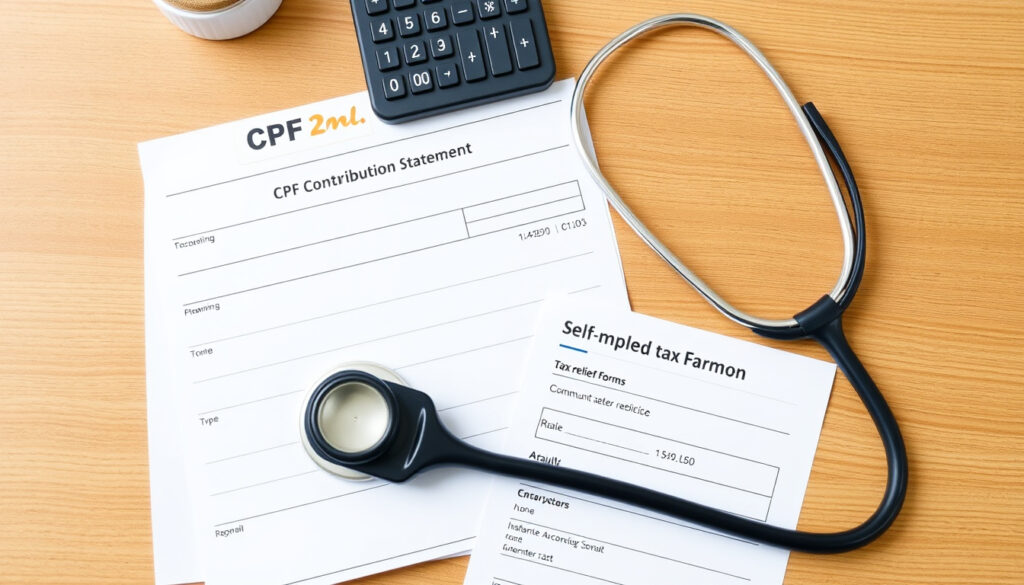
Self-Employed CPF Contribution: MediSave, Top-Ups & Tax Relief
If you’re self-employed in Singapore, you might assume CPF is something only salaried employees deal with, but there’s a compulsory MediSave obligation once net trade income exceeds S$2,000 a year. This guide walks through what you owe, how to calculate it, and where voluntary top-ups can cut your tax bill.
CPF annual contribution limit: S$37,740 · Compulsory MediSave rate (age <35): 8% of net trade income · Tax relief cap on CPF contributions: Up to 37% of net trade income or S$37,740 · Minimum earnings triggering MediSave: S$2,000/year
Quick snapshot
- Self‑employed must contribute to MediSave if net trade income exceeds S$2,000 (CPF Board guidance)
- CPF annual limit for self‑employed relief is S$37,740 (CPF Board)
- Compulsory MediSave due 30 days from CPF contribution notice (CPF Board timeline)
- Exact future changes to contribution rates after 2025 (subject to government review)
- Clarity on income calculation for platform workers vs. traditional self‑employed
- The precise aggregation rules for multiple income streams in net trade income calculation
- From YA 2026: full tax relief on compulsory MediSave even with zero assessable net trade income (IRAS relief rule)
- YA 2026 also caps voluntary relief when compulsory MediSave exceeds 37% of NTI (IRAS)
- Platform work earnings excluded from self‑employed NTI calculation from 2025 (CPF Board rule change)
- Voluntary top‑ups now capped more tightly under YA 2026 rules (CPF Board rule change)
Six facts, one pattern: the system pushes self‑employed individuals toward MediSave first, then offers tax relief as an incentive for voluntary savings.
| Item | Value |
|---|---|
| Compulsory MediSave threshold | Net trade income > S$2,000/year |
| MediSave rate (age <35) | 8% |
| MediSave rate (age 35–45) | 9% |
| MediSave rate (age 45–50) | 10% |
| MediSave rate (age 50+) | 11% |
| CPF annual limit | S$37,740 |
The implication: your age bracket directly sets how much is siphoned into your MediSave Account before you see any tax benefit.
Do self‑employed need to contribute to CPF?
The short answer: yes, but only to MediSave — not to your Ordinary Account or Special Account — unless you choose to top up voluntarily. Under the CPF Board’s rules for self‑employed persons, if your net trade income exceeds S$2,000 a year, you must contribute to your MediSave Account at a rate determined by your age. Freelancers and sole traders are all considered self‑employed under these rules. Platform workers — think delivery riders and gig drivers — face a separate treatment from 2025.
“Self-employed persons are required to contribute to MediSave if their net trade income exceeds $2,000 per year.” — CPF Board guidance
What is the difference between compulsory MediSave and voluntary CPF contributions?
- Compulsory MediSave: This is a mandatory set-aside for hospitalisation and medical expenses. It cannot be withdrawn for other purposes.
- Voluntary contributions: You may also deposit cash into your Ordinary Account, Special Account, or Retirement Account. These are optional but can boost retirement savings and — subject to caps — qualify for tax relief.
A self‑employed freelancer earning S$50,000 net trade income at age 30 owes S$4,000 in compulsory MediSave (8%), but can top up another S$14,540 to reach the S$37,740 annual limit and claim tax relief on the total.
Who qualifies as self‑employed for CPF purposes?
The CPF Board’s definition includes sole proprietors, freelancers, and partners in a business. From 2025, platform work earnings — such as income from GrabFood deliveries or Gojek rides — are excluded from your net trade income for CPF calculation, per a policy shift that CPF Board guidance details.
Why this matters: if you mix traditional freelance income with platform gigs, only the former counts toward the S$2,000 threshold for compulsory MediSave — potentially lowering your obligation.
What is the CPF rate for self‑employed people?
The MediSave rate is purely age‑based. Unlike salaried employees who split contributions across all CPF accounts at a combined 37% (employee 20% + employer 17% up to the S$8,000 monthly wage ceiling, according to PwC Tax Summaries), self‑employed individuals contribute only to MediSave — unless they choose to add to other accounts. The IRAS CPF relief page confirms the age tiers shown in the snapshot table above.
The rates climb with age, reflecting higher anticipated medical costs.
| Age | MediSave rate (% of NTI) |
|---|---|
| Below 35 | 8% |
| 35 to 44 | 9% |
| 45 to 49 | 10% |
| 50 and above | 11% |
One pattern: the rate climbs as you age, reflecting higher anticipated medical costs.
How does the CPF annual limit affect contributions?
The CPF annual limit of S$37,740 caps the total contributions (compulsory plus voluntary) that qualify for tax relief. For self‑employed persons, your relief is the lower of:
- 37% of net trade income
- The S$37,740 annual limit
- Your actual contributions (compulsory MediSave + any voluntary top‑ups that meet the rules)
The catch: voluntary contributions that push you past the cap still count as savings but do not reduce your tax bill.
The pattern: the annual limit ensures that even high earners cannot claim relief beyond S$37,740, making voluntary top‑ups above that purely savings tools.
How to calculate CPF contribution for self‑employed?
Calculation is straightforward: compulsory MediSave = net trade income × age‑based rate. For example, a 40‑year‑old freelancer with net trade income of S$60,000 owes S$5,400 (9%) to MediSave. The CPF Board’s online calculator for self‑employed can handle these figures automatically.
How to calculate compulsory MediSave contributions?
- Determine your net trade income (gross revenue minus deductible expenses).
- Find your age bracket from the table above.
- Multiply NTI by the rate. If NTI ≤ S$2,000, no contribution is due.
How to calculate voluntary contributions to SA/OA?
Voluntary contributions can be made via CPF e‑Cashier or GIRO. To get tax relief, your total contributions must stay within the S$37,740 annual limit. For YA 2026, the IRAS relief rule states that voluntary CPF relief is capped at the lowest of 37% of NTI (less compulsory MediSave), S$37,740, or actual amount if MediSave <37% NTI. No voluntary relief is available if your compulsory MediSave already exceeds 37% of NTI.
A self‑employed person earning S$200,000 NTI owes S$22,000 in compulsory MediSave (11% at age 50) — which is already below the cap — so voluntary top‑ups of up to S$15,740 (S$37,740 minus S$22,000) still qualify for relief. But for a high‑earner, the 37% of NTI cap is S$74,000, so the S$37,740 limit is the binding constraint.
What is the CPF contribution calculator for self‑employed?
The CPF Board’s digital service — available at cpf.gov.sg/e‑services/calculate‑cpf‑contributions — lets you enter your age and net trade income to see your compulsory MediSave amount and the room left for voluntary contributions.
The pattern: the calculator is the fastest way to avoid over‑contributing past the relief cap.
How much tax will I pay if I’m self‑employed?
You pay income tax on net trade income after deductible business expenses. Tax rates follow Singapore’s progressive schedule — the first S$20,000 is untaxed, then 2% for S$20,001–S$30,000, and so on up to 24% for amounts above S$1 million (IRAS individual income tax rates). Your CPF contributions reduce your assessable income.
“CPF contributions by a self-employed person are eligible for tax relief up to 37% of net trade income or the CPF annual limit, whichever is lower.” — IRAS
How does CPF relief reduce taxable income?
The CPF relief for self‑employed persons works as a deduction from your total income. For YA 2025 (income year 2024), the relief was the lower of 37% of NTI, S$37,740, or actual contributions. For YA 2026, the rule expands: you get full relief on compulsory MediSave even if you have zero assessable NTI, but voluntary relief is capped more strictly.
Example: a self‑employed consultant with NTI of S$80,000 at age 42 owes S$7,200 in MediSave (9%). If she voluntarily tops up S$20,000 to her Special Account, her total contribution is S$27,200 — still under the S$37,740 limit and well within 37% of NTI (S$29,600). Her CPF relief reduces her taxable income from S$80,000 to S$52,800.
What is the difference between tax on salary vs self‑employment income?
Salaried employees get employer CPF contributions added automatically (17% on up to S$8,000 monthly ordinary wages, per PwC Tax Summaries). Self‑employed individuals get no employer contribution — they must fund their own MediSave and any voluntary savings. However, self‑employed persons can deduct business expenses directly, which salaried employees cannot.
The implication: a self‑employed person with the same gross income as an employee may have lower taxable income if business expenses are significant, but they also shoulder the full CPF contribution burden.
Can I voluntarily top‑up to my Ordinary Account only?
Yes, you can contribute to your Ordinary Account directly. However — and this is a common trap — voluntary contributions to the OA do not qualify for tax relief unless they fall within the annual limit that covers all CPF accounts. The IRAS CPF Cash Top‑Up Relief separately allows up to S$8,000 for your own SA/RA and S$8,000 for family members, for a total of S$16,000 per year — but OA top‑ups are not covered by that scheme.
What are the rules for voluntary CPF contributions?
- You can contribute to any CPF account (OA, SA, MA, RA).
- Only contributions to SA/MA/RA (or within the annual limit) qualify for the self‑employed CPF relief.
- CPF Board’s tax relief FAQ notes that cash top‑ups to your own SA/RA are eligible for the cash top‑up relief, separate from the self‑employed relief.
What is the maximum tax relief for voluntary top‑ups?
The total CPF relief available to a self‑employed individual combines the self‑employed relief (based on NTI) and the cash top‑up relief (up to S$8,000 for self, S$8,000 for family). For YA 2026, these are not additive on the same income — the self‑employed relief already captures compulsory MediSave; the cash top‑up relief is a separate deduction for direct SA/RA contributions.
The pattern: careful planning is needed to stack reliefs without exceeding caps.
Why this matters: for the self‑employed professional earning S$100,000 at age 40, the compulsory MediSave bite is S$9,000, but voluntary top‑ups of up to S$28,740 can be tax‑relieved — effectively making every dollar saved cost less than face value.
youtube.com, khelvinxu.com, income.com.sg, iras.gov.sg, cpf.gov.sg
Frequently asked questions
What happens if I do not pay my compulsory MediSave contributions?
The CPF Board will issue a notice of contribution, and the amount is due within 30 days. Late payment may attract interest charges and penalties, similar to other tax obligations.
Can I use MediSave savings to pay for hospitalisation insurance?
Yes. MediSave can cover hospitalisation expenses and approved insurance premiums, such as Integrated Shield Plan premiums, under CPF Board usage guidelines.
Are voluntary CPF contributions eligible for tax relief if I already hit the annual limit?
No. Any contribution above S$37,740 in total does not receive additional relief. The cap is absolute, per IRAS CPF relief rules.
Do I need to contribute to CPF if I am a freelancer earning less than S$2,000 per year?
No. The requirement only starts when net trade income exceeds S$2,000. Below that threshold, no compulsory MediSave is due.
How do I claim CPF relief on my tax return?
Your compulsory MediSave contributions are automatically reflected in your tax assessment if your income is captured by IRAS. For voluntary contributions, you need to declare the amount in your tax return under the CPF relief section.
Can I make a one-time voluntary top-up to my CPF account?
Yes. You can make a one-time cash top-up via CPF e‑Cashier. The amount is credited to your chosen account (SA, OA, or MA) and may qualify for relief depending on the account.
Does employer CPF contribution apply to self-employed individuals?
No. By definition, a self‑employed person has no employer. You are solely responsible for your MediSave contributions and any voluntary savings.
Related reading
- CPF Minimum Sum 2026: BRS S$110,200 FRS S$220,400 Explained – Understand the Retirement Sums that affect when you can withdraw your CPF savings.
- Monetary Authority of Singapore – Roles, Functions and Policy – The central bank context for financial regulation that shapes CPF rules.
For the self‑employed person in Singapore, the decision is clear: contribute at least the compulsory MediSave, then top up within the S$37,740 or 37% of NTI cap to maximise tax relief — or leave money on the table that the taxman would otherwise take.
More related posts
 Soldier Poet King Quiz: Meaning, Song Story & TikTok Trend
 Best Miles Credit Card Singapore: Don’t Just Chase Earn Rates
 AIMS APAC REIT Dividend: History, Yield & Pay Dates
 Singapore Prayer Schedule 2025: Daily Times, Eid & Duha
 Heart to Heart Jewellery: Meaning & Styling Rules for 2025
 How to Organize a Laundry Room: Tips, Must-Haves, and Steps
 What to Do in Taiwan: Top Attractions & Itineraries
 Things to Do Today – Free Scavenger Hunts Near Moss Point
