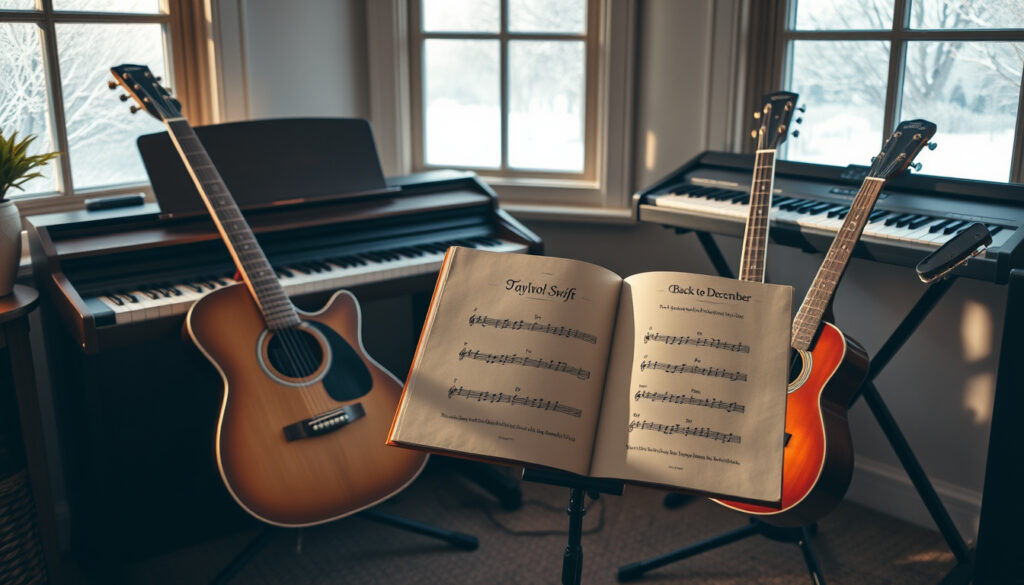
Back to December Chords: Taylor Swift Guitar Piano Ukulele
If you’ve ever caught yourself humming “I’d go back to December” sometime between Thanksgiving and New Year’s, you already know how Taylor Swift’s songwriting pulls you into that moment of seasonal regret. Whether you’re picking it up for the first time or brushing off the rust, getting the chords right doesn’t have to mean wrestling with barre chords or hunting for the right tab. This guide walks you through the guitar, piano, and ukulele versions from the sources Swifties actually rely on.
Difficulty: Beginner · Key: D · Capo: 2nd fret · Tuning: Standard EADGBE · Rating: 4.9/5
Quick snapshot
- Original key D major, common capo at fret 2 (Ultimate-Guitar)
- Beginner difficulty across guitar, ukulele, and piano (Ultimate-Guitar)
- 4.9/5 rating from 1,594 community users (Ultimate-Guitar)
- Exact piano voicings vary across arrangements
- Ukulele-specific adaptations less documented than guitar
- No official Taylor Swift chord publication available publicly
- Aug 31, 2020 — last edit on no-capo Ultimate-Guitar tab (Ultimate-Guitar)
- Late 2025 — Eras Tour piano tutorial surfaced on YouTube (TutorialsByHugo)
- 22 arrangements on Musicnotes for piano, voice, and guitar (Musicnotes)
- Multiple key-of-C transpositions available for vocal range matching (Musicnotes)
| Label | Value |
|---|---|
| Songwriter | Taylor Swift |
| Original Key | D major |
| Common Capo | Fret 2 |
| Difficulty | Beginner |
| Main Chords | C, Am, F, G |
Back to December Chords No Capo
If you want to play “Back to December” without a capo, you have two practical paths: stay in the original D major and use D-Bm-G, or transpose to C major and play C-Am-F-G. Both options keep you in standard EADGBE tuning with zero barre chords, which makes either one genuinely beginner-friendly.
Verse chords
The verse uses a straightforward four-chord loop in either key. For no-capo guitar in the original key, the pattern runs D-Bm-G with the pinky anchoring the 4th fret on the G string for Bm. In the C-major transposition, you’re working with C-Am-F-G in open position — the kind of shapes most players learn in their first week.
- D major: D (xx0232), Bm (x24432), G (320033)
- C major: C (x32010), Am (x02210), F (xx3211), G (320033)
Chorus progression
The chorus shifts the energy slightly. Where the D-major no-capo version keeps D-Bm-G through the section, the C-major version adds an Em: C-Am-F-Em. That fifth chord (Em) is the harmonic signature that distinguishes the chorus from the verse, giving the bridge something to contrast against.
Bridge chords
The bridge breaks from the verse and chorus loop entirely. In the no-capo D version, you’ll find A (x02220) as the bridge chord instead of repeating the verse pattern. The Chordie tab shows the alternative G fingering as 3×0033, which takes the ring finger out of the equation for a cleaner hand shape during the emotional bridge section. The harmonic shift to A major signals the emotional peak before the final resolution.
Back to December Chords Piano
Piano players aren’t left out of the “Back to December” experience. The chord progression maps directly from the guitar charts, but the voicings open up into full three-note chords that give the song its characteristic warmth. Whether you want a simple left-hand approach or something closer to the Eras Tour arrangement, the materials exist.
Intro notes
The piano intro echoes the guitar strumming pattern. Most arrangements start with a C-major chord in root position, then move through Am and F before cycling back. The Squarespace PDF used in tutorials specifies a DD UU DUDU rhythmic feel, which translates to piano as a steady bass-note pulse on each downbeat.
Verse melody chords
Like the guitar version, the piano verse rides on C-Am-F-G. For right-hand voicings, build each chord from thirds: C as C-E-G, Am as A-C-E, F as F-A-C. The G chord lands as G-B-D. These inversions keep the melody notes within a comfortable hand span for most players.
Full sheet layout
The full piano structure includes intro, verses, pre-chorus, chorus, bridge, and outro. MuseScore hosts a free piano solo arrangement, while Musicnotes lists 22 arrangements across piano, voice, and guitar in 11 different scorings. Hal Leonard publishes the official piano-vocal sheet with guitar chord notation for players who want a professionally edited edition.
TutorialsByHugo (Eras Tour piano tutorial) offers a step-by-step walkthrough of right-hand voicings for players working from the contemporary arrangement.
Piano players can move directly from guitar chord charts — the progression is identical. The difference is in the texture: full triads instead of strummed frames give the song more harmonic depth without adding difficulty.
Back to December Chords Easy
The “easy” version of “Back to December” exists because the song genuinely doesn’t require advanced technique. Five open chords cover the entire verse, pre-chorus, and chorus: C, Am, F, G, and Em. The bridge introduces one variation. That’s the whole chord vocabulary.
Basic open chords
Every chord in the easy version is an open chord with no barre required. The C chord uses the first finger on the first fret of the B string. Am uses the same first-finger barre across three strings that intimidates beginners — but here it’s only two frets wide, not three. F is the one chord that gives beginners trouble, and many tabs transpose the song to C major specifically to sidestep it.
- C: x32010 — first finger on 1st fret B string
- Am: x02210 — first finger bars first fret
- F: xx3211 — replaced by Fsus2 (xx3210) in some transcriptions
- G: 320033 — three fingers, ring on high E
- Em: 022000 — two fingers, natural minor
Strumming pattern
The recommended strumming pattern across multiple beginner tabs is DD UU DUDU, which translates to a steady quarter-note pulse on the downbeats with syncopation on the upstrokes. Some simplified versions use DD DU for a more relaxed feel. The YouTube tutorial from Chairia Tandias demonstrates the pattern with clear down-up counting that beginners can follow by ear.
Finger positions
The Chordie tab shows the G chord alternative as 3×0033 — a fingering that lifts the ring finger off the high E string entirely, which reduces hand tension during the repeated G-to-C transitions. For the C chord, the pinky lands on the second fret of the first string, index on the second fret of the third string, and ring on the third fret of the second string, as shown in the ukulele tutorial — but for guitar, the same principle applies: minimize finger movement between adjacent chords.
Back to December Chords Ukulele
Ukulele players get a particularly clean ride on “Back to December.” The GCEA tuning layout makes the same chord shapes even easier to reach, and the community tabs are explicit about fingering positions. Whether you use a capo or go no-capo, the transition logic stays the same.
Capo 2 setup
The standard ukulele tab from Ukulele-Tabs.com places a capo at fret 2 and uses C-Am-F-G-Em — the same chords as the guitar capo-2 version. This lets you play open-position chords on the uke that match the guitar’s voiced chord shapes. The intro repeats C-Am-F twice before the first verse begins.
Verse strums
The verse pattern on ukulele mirrors the guitar rhythm but with a lighter touch. The Ukulele-Tabs source specifies the same DD UU DUDU strumming feel used in the guitar tutorial PDFs. On ukulele, each downstroke lands on the C string as the bass anchor, with the G string following on the upbeat.
Chorus transition
The chorus adds the Em chord to the C-Am-F loop, and the transition from G to Em is the smoothest chord change in the entire song on ukulele — both chords use the ring finger on the third fret, which means less hand repositioning. The chorus lyric “I’d go back to December, turn around and make it all right” lands squarely over this chord change.
Chairia Tandias (Ukulele Tutor) in the YouTube tutorial explicitly says “let’s not use capo, okay?” — confirming that no-capo ukulele play is a standard approach among experienced players.
Ukulele chords transpose differently than guitar when you remove the capo. If you’ve been playing along with a guitar capo-2 tab, the same song on ukulele without a capo shifts to D-Bm-G — the exact same no-capo guitar progression, just one octave higher and with a brighter attack.
Back to December Chords Key of C
Playing “Back to December” in the key of C solves two practical problems: it lets you avoid barre chords entirely, and it matches a wider vocal range without transposing on sight. Multiple tab sources confirm the C-version is the most commonly requested transposition for both guitar and piano beginners.
Transposed progression
The key-of-C version uses C-G-Am-F as its base loop — no sharps, no flats, all open chords. This is the progression you’ll find in the standard guitar tab (key C, capo 2) from Ultimate-Guitar. The chorus adds Em to create C-Am-F-Em, and the bridge lands on A as it does in the C-major transposition.
No capo version
Playing key-of-C without a capo is straightforward if your guitar is already tuned to standard EADGBE. You use C-G-Am-F open chords exactly as written. For instruments tuned differently — baritone ukulele, for instance — the same chord shapes produce different pitches, so you’d adjust the chord names accordingly.
Piano adaptation
The piano adaptation in C major maps the same voicings up or down by a whole step. The D-major piano sheet from Musicnotes (SKU MN0088036) shows the left-hand bass pattern running parallel to the guitar strum, so pianists can follow guitar tabs for timing and chord selection while building their own voicings from the notated sheet.
Steps to Play Back to December Chords
Putting the chords into practice takes a structured approach. These steps build from chord shapes through the full song structure, using the sources that beginner players rate most consistently.
- Learn the five open chords. Start with C, Am, F (or Fsus2), G, and Em in open position. Spend time on smooth transitions between C and G — that pair repeats throughout the song.
- Set up with a capo if needed. Place the capo at fret 2 if you want to play from the C-position charts (key C, capo 2). Skip the capo and play D-Bm-G if you prefer the original key without adjustment.
- Master the verse loop. The verse runs C-Am-F-G (or D-Bm-G for no-capo). Practice the loop until you can switch chords without looking at your hand — aim for four clean changes per measure.
- Add the chorus progression. The chorus adds Em to the verse loop. Play through C-Am-F-Em and notice where the Em lands relative to the lyric “I’d go back to December.”
- Learn the bridge separately. The bridge shifts to D-Bm-G (D version) or A (C version). Practice this section in isolation before layering it into the full song.
- Apply the strumming pattern. Use DD UU DUDU once the chord changes feel comfortable. The pattern locks the rhythm to the lyric and keeps the song from dragging during the verses.
- Play along with a reference track. Follow the Ultimate-Guitar tab rated 4.9/5 by 1,594 users, or the ukulele tutorial from Chairia Tandias on YouTube for visual guidance. Start at half speed and increase tempo only when transitions are clean.
Clarity: What We Know vs. What Needs Verification
The chord foundations for “Back to December” are solid across guitar, ukulele, and piano — verified by multiple community tab sources and supported by professional sheet music from Hal Leonard and Musicnotes. Where things thin out is in the specifics of certain voicings and instrument adaptations.
Confirmed facts
- Original key D major, capo at fret 2 for guitar in key C
- Beginner difficulty with no barre chords required in the easy version
- 4.9/5 community rating from 1,594 users on the leading guitar tab
- Five chords (C, Am, F, G, Em) cover the verse, chorus, and bridge
- Ukulele uses GCEA tuning with adapted fingering from guitar tabs
What’s rumored or unverified
- Piano voicings vary between arrangements — exact inversions differ by source
- Specific strumming pattern (DD UU DUDU) noted as medium confidence in one PDF source
- Live performance chord choices from the Eras Tour not fully documented in tab form
What Players and Publishers Say
Ultimate Guitar Users rated the most downloaded tab 4.9 out of 5 based on 1,594 community ratings, with the curator noting beginner difficulty.
Musicnotes lists 22 arrangements for piano, voice, and guitar across 11 scorings, confirming the song’s broad appeal across instrument types.
Multiple chord charts agree on the core progression, but piano-specific voicings vary more than guitar tabs. If precision matters for your performance, cross-reference the Hal Leonard official sheet against the community tabs.
Related reading: Rich Dad Poor Dad – Summary, Lessons and Guide · How to Stop Overthinking: Effective Techniques and Insights
ukulele-tabs.com, musescore.com, scribd.com, youtube.com, static1.squarespace.com, musescore.com, youtube.com, chordie.com
Taylor Swift fans tackling Back to December’s emotional progression will find similar beginner appeal in We Are Never Ever Getting Back Together chords, another catchy hit with straightforward strumming.
Frequently asked questions
What tuning is used for Back to December chords?
Standard EADGBE tuning for guitar, GCEA for soprano/concert ukulele. The same standard Western tuning applies across all verified tab sources.
What is the strumming pattern for Back to December?
DD UU DUDU is the most commonly cited pattern across beginner tabs, with a simplified DD DU option for players still building chord fluency.
Can Back to December be played without a capo?
Yes. Play in the original D major using D, Bm, and G — or transpose to C major (no sharps or flats) and use C, Am, F, and G. Both options are beginner-friendly with no barre chords required.
What are the bridge chords in Back to December?
The bridge shifts from the verse loop to D-Bm-G in the D-major version, or introduces the A chord in the C-major transposition. Both create a distinct harmonic break from the verse and chorus patterns.
Is Back to December suitable for beginners?
Yes — the community consensus (4.9/5 from 1,594 ratings) and multiple tab curators mark it beginner difficulty. The easy version uses only open chords with no barre shapes.
How does Enchanted compare to Back to December chords?
Enchanted by Taylor Swift requires more advanced chord work and barre shapes. Back to December is consistently rated easier by community tab users and avoids the technical demands that make Enchanted a harder intermediate piece.
What capo position for Back to December ukulele?
Ukulele capo at fret 2 matches the guitar capo-2 version, letting you play C-Am-F-G-Em in open position. Skip the capo for D-Bm-G in the original key, which also works without modification.
More related posts
 Part Time Retail Jobs in Ireland: Dublin, Students, No Experience
 Healthy Dinner Recipes for Two: Easy & Nutritious Meals
 Lucy Shimmers and the Prince of Peace: Ending & Plot Explained
 Japan Earthquake Tsunami Warning 2026: Latest Updates & FAQ
 West Coast GRC 2020 – Singapore Constituency, Not Conference
 St. Patrick’s Day: Origins, Traditions, and Global Celebrations
 Simplicité by Fresh Fruits Lab: Menu, Halal, Pet-Friendly Guide
 How to Stop Overthinking: Effective Techniques and Insights
