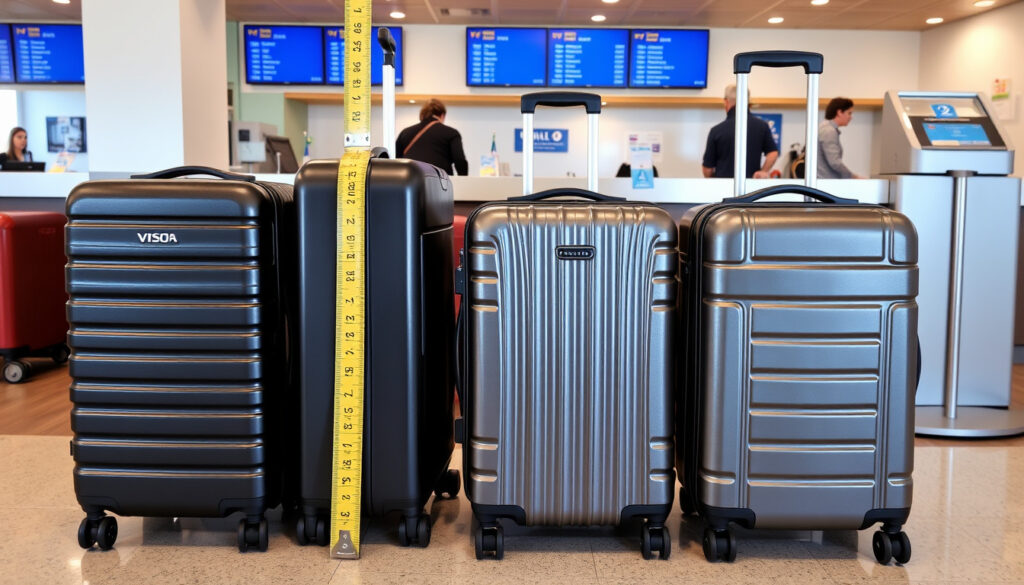
Cabin Size Luggage Inch: 20, 22, 24 Inch Guide & Airline Limits
If you’ve ever stood at the airport check-in counter nervously eyeing your suitcase, you’re not alone. One of the most common travel headaches is figuring out whether your 20, 22, or 24-inch bag will make it past the gate. This guide cuts through the confusion with airline-specific policies, weight limits, and a clear breakdown of what actually fits in the cabin.
Standard cabin size (IATA): 56 x 36 x 23 cm (22 x 14 x 9 in) ·
Ryanair free personal item: 40 x 30 x 20 cm ·
Ryanair priority cabin bag: 55 x 40 x 20 cm ·
easyJet free cabin bag: 45 x 36 x 20 cm ·
Typical weight limit: 7-10 kg ·
Southwest carry-on max: 24 x 16 x 10 in
Quick snapshot
- Nearly always accepted as cabin size (Ryanair (official bag policy))
- Check weight limits (7-10 kg) (Ryanair (official bag policy))
- Fits most overhead bins and some under-seat (Ryanair (official bag policy))
- Standard cabin size for most full-service carriers (Global Rescue (travel security advisory))
- Exact limits vary: some allow 22.5 in (Global Rescue (travel security advisory))
- Include wheels and handle in measurement (Global Rescue (travel security advisory))
- Usually too large for carry-on (Southwest (official carry-on policy))
- Only a few airlines may accept (Southwest (official carry-on policy))
- Better used as checked baggage (Southwest (official carry-on policy))
- Weigh your bag before travel
- Measure at the widest points
- Low-cost airlines are stricter
Seven key dimensions, one pattern: the standard 22 x 14 x 9 inch bag works on most major airlines, but budget carriers shrink the allowance significantly.
| Label | Value |
|---|---|
| Standard cabin size (IATA) | 56 x 36 x 23 cm (22 x 14 x 9 in) |
| 20-inch typical allowance | Accepted by nearly all airlines |
| 22-inch typical allowance | Accepted by most full-service carriers |
| 24-inch typical allowance | Rejected by most airlines |
| Ryanair personal item | 40 x 30 x 20 cm |
| Ryanair priority cabin bag | 55 x 40 x 20 cm |
| Common weight limit | 7-10 kg |
The implication: if you fly budget, your free allowance is smaller than a typical 20-inch roller. That trade-off matters more than the bag height alone.
What is the standard size for cabin luggage?
The International Air Transport Association (IATA) recommends a maximum cabin bag size of 56 x 36 x 23 cm, which equals 22 x 14 x 9 inches. Many full-service airlines adopt this as their limit (American Airlines (official carry-on page)). But the standard varies in practice, especially across low-cost carriers.
Dimensions in inches and centimeters
- IATA guideline: 56 x 36 x 23 cm (22 x 14 x 9 in)
- Southwest Airlines: 24 x 16 x 10 in (61 x 41 x 25 cm) – more generous (Southwest (official carry-on policy))
- Ryanair free bag: 40 x 30 x 20 cm – much smaller
- easyJet free bag: 45 x 36 x 20 cm – slightly larger than Ryanair
Comparison of standard sizes across major airlines
One glance at the table tells the story: full-service airlines hover near the IATA benchmark while budget airlines tighten both height and depth.
| Airline | Free cabin bag (cm) | Max weight | Notes |
|---|---|---|---|
| Ryanair (no priority) | 40 x 30 x 20 | None (must fit under seat) | Small personal item only |
| Ryanair (priority) | 55 x 40 x 20 | 10 kg | Additional overhead bag allowed |
| easyJet | 45 x 36 x 20 | None (must fit under seat) | Free for all passengers |
| American Airlines | 56 x 36 x 23 | No specific weight | Plus personal item 18 x 14 x 8 in |
| United Airlines | 56 x 36 x 23 | No specific weight | Plus personal item |
| Southwest Airlines | 61 x 41 x 25 | No weight limit | Largest allowance |
The catch: even a 20-inch standard spinner may exceed easyJet’s 20 cm depth. That slim profile is what often gets travellers at the gate.
Budget airlines have redesigned their free allowances around soft bags and backpacks, not hard-shell suitcases. A traveller with a 20-inch spinner faces a much higher risk on Ryanair than on Southwest.
Common weight limits
- Most airlines allow 7-10 kg for cabin luggage.
- Ryanair’s priority bag is limited to 10 kg (Ryanair (official bag policy)).
- easyJet has no weight limit for the free cabin bag but requires you to lift it yourself.
- US carriers typically do not enforce a weight limit for carry-on, but TSA rules on liquids remain (United Airlines (official bag guidance)).
Why this matters: a heavy bag in a small frame is more likely to be gate-checked. Pack dense items in your personal item instead.
Is 20 inch luggage cabin size?
Generally, yes. A 20-inch suitcase (roughly 50 cm tall including wheels) fits within the overhead bins of most narrow-body and wide-body aircraft. However, its depth (typically 20-23 cm) can be problematic on strict low-cost carriers.
What is the weight limit for 20-inch luggage?
- Budget airlines: often 7 kg (Ryanair, Wizz Air).
- Full-service carriers: often 10 kg or no published limit.
- Check your ticket – some weight allowances are tied to the fare class.
Does 20 inch luggage fit under the seat?
- Ryanair’s under-seat space requires a personal item of 40x30x20 cm – smaller than most 20-inch bags.
- easyJet’s under-seat space is 45x36x20 cm – still a tight fit for many 20-inch spinners.
- For under-seat use, a soft duffle or backpack is safer.
Airlines that accept 20-inch bags as carry-on
- American Airlines: yes (if within 56x36x23 cm).
- United Airlines: yes.
- Ryanair: only if you buy priority (the free bag is too small).
- easyJet: only if the bag fits the 45x36x20 cm sizer – many 20-inch rollers do not.
The trade-off: a 20-inch bag is versatile for full-service travel but may cost extra on budget airlines where a free ticket only gets a soft bag.
The depth (second dimension) is the real gatekeeper on budget carriers. A bag that is 20 inches tall but 23 cm deep will fail the easyJet sizer regardless of height.
Can a 22 inch luggage be a carry-on?
Yes – for most full-service airlines. 22 inches (56 cm) is the industry standard height, including wheels and handle. But tolerance varies: some airlines allow up to 22.5 inches, others enforce a strict 22-inch limit.
Is 22.5 inches too big for carry-on?
It depends on the airline. Southwest Airlines (official carry-on policy) explicitly allows up to 24 inches. Many European carriers, however, measure precisely at the boarding gate. If your bag is 22.5 inches, check the width and depth first – those often cause rejection.
Which airlines accept 22-inch carry-on?
- American Airlines: accepts 22 x 14 x 9 in bags.
- United Airlines: accepts up to 22 inches.
- Air France, Lufthansa, British Airways: follow the IATA standard.
- Ryanair, easyJet, Wizz Air: do not accept a 22-inch bag as the free item.
What to do if your 22-inch bag is slightly oversized
- Measure with wheels and handle extended – these count.
- If only 0.5 inches over, some gate agents may allow it if the bin isn’t full.
- Consider a soft-sided bag that compresses slightly.
The pattern: full-service airlines grant a few centimetres of tolerance; budget airlines use metal sizers that enforce the exact number.
Is a 24 inch suitcase cabin size?
Rarely. A 24-inch suitcase (about 61 cm tall) exceeds the IATA guideline and the limits of almost all airlines.
Which airlines allow 24-inch carry-on?
- Southwest Airlines: allows 24 x 16 x 10 in explicitly.
- Alaska Airlines: allows 24 x 17 x 10 in (check current policy).
- Delta Air Lines: typical limit is 22 x 14 x 9 in – 24 in is rejected.
- All European low-cost carriers: reject 24-inch.
What size suitcase is considered oversized?
Any bag taller than 56 cm (22 in) or deeper than 23 cm (9 in) is oversized for most international flights. A 24-inch bag is best used as checked luggage.
24-inch bag as checked luggage
- Most airlines accept 24-inch bags as checked baggage within standard weight limits (23 kg / 50 lbs).
- Check your fare – basic economy may charge for any checked bag.
The verdict: unless you fly Southwest, a 24-inch suitcase in the cabin is a gamble that often ends at the gate-check desk.
Which airlines allow a 24-inch carry-on?
Only a few carriers officially allow it. Southwest is the most notable. Some US carriers may accept a 24-inch bag if it fits the sizer, but the risk is high.
International airlines with generous carry-on allowances
- Southwest: 24 x 16 x 10 in (Southwest (official carry-on policy))
- Alaska Airlines: up to 24 x 17 x 10 in (check current page).
- Air France: standard 55 x 35 x 25 cm – borderline for a slim 24-inch bag.
Budget airlines that reject 24-inch
- Ryanair: max height 55 cm with priority – 24 in (61 cm) is too tall.
- easyJet: max height 45 cm for free bag – no chance.
- Wizz Air: max 40 x 30 x 20 cm for free bag.
How to check your airline’s exact policy
- Visit the airline’s official baggage page – not third-party summaries.
- Look for both height and depth limits.
- Some airlines provide a downloadable sizer template.
Why this matters: relying on a 24-inch carry-on for a budget flight will cost you a checked-bag fee or force an upgrade.
Southwest’s generous limit suggests that aircraft bins can hold larger bags, but most airlines choose to restrict height to maximise overhead space for all passengers. The traveller pays the price for that competition.
Confirmed facts vs what’s unclear
- 22 x 14 x 9 inches is a widely accepted standard (Global Rescue (travel security advisory)).
- Ryanair’s cabin bag limits are 40x30x20 cm (small) and 55x40x20 cm (priority).
- 24-inch suitcases exceed the limits of most airlines.
- Exact tolerance for over-sized bags (e.g., 22.5 vs 22 inches) varies by airline and gate agent.
- Whether a 24-inch bag can be squeezed into an overhead bin depends on aircraft type.
- The extent to which weight limits are enforced varies significantly between US and European carriers.
Expert perspectives on cabin luggage sizing
“A carry-on suitcase generally measures around 22 x 14 x 9 inches (56 x 36 x 23 cm).”
“Small underseat bag must be 40 x 30 x 20 cm; priority cabin bag can be 55 x 40 x 20 cm.”
— Ryanair (official bag policy)
“Our cabin suitcases typically measure 55x40x20cm or similar, depending on the style.”
For travellers flying full-service airlines, a 22-inch bag remains the safest bet. But anyone booking a budget carrier like Ryanair or easyJet must match their free allowance to a soft, slim bag – or pay for priority. The trade-off between bag size and airline savings is clear: you can save money on the fare, but you may need to downsize your suitcase or pay an extra fee. For the frequent European traveller, the choice is: pack lighter or budget for priority.
easyjet.com, help.ryanair.com, easyjet.com, antler.com, easyjet.com, youtube.com, tripadvisor.com
For a broader overview of airline carry-on policies across different carriers, check out this general carry-on luggage guide covering dimensions, weight limits, and tips.
Frequently asked questions
What happens if my bag is slightly over the size limit?
You may be asked to check it at the gate, incurring a fee (often €40-€70) or forced to fit it into a sizer. Gate agents have final discretion.
Do wheels and handles count in luggage dimensions?
Yes. Airlines measure the bag at its widest point, including wheels and handles. Always measure your bag fully extended.
Is cabin luggage size the same as carry-on?
Generally yes, but some airlines distinguish between a personal item (under seat) and a cabin bag (overhead). Check the terminology for your flight.
Can I take a backpack as cabin luggage?
Yes, as long as it fits within the airline’s size limits. Many backpacks comply with the 40x30x20 cm rule for budget airlines.
What is the cheapest way to ensure my luggage fits carry-on?
Buy a soft-sided bag no larger than 45x36x20 cm, or stick to a backpack that fits under the seat. Avoid hard-shell suitcases for budget flights.
Are there separate size limits for regional jets?
Yes. Regional jets have smaller overhead bins. Some airlines restrict carry-on to smaller dimensions on regional or turbo-prop aircraft.
How strict are airlines about carry-on weight limits?
European low-cost airlines (Ryanair, easyJet) are stricter than US carriers. If your bag exceeds 7-10 kg, you may be asked to repack at the gate.
More related posts
 Everton F.C. vs Arsenal F.C.: 2-0 Result, Highlights & H2H
 Charlie Kirk Death Video: Latest Verified Information (Sept 2025)
 Watch Shop Far East Plaza: Luxury, Pre-Owned, Ladies & More
 Ahn Jae-hyun – Career Dramas and Divorce Facts
 West Coast GRC 2020 – Singapore Constituency, Not Conference
 Badminton Indonesia Masters 2026: Results, Dates & Prize Money
 Atlético Madrid vs Real Madrid: Record, Stats & 5-2 Win
 Singapore COE Prices Rise: Latest Results and Renewal Impact
