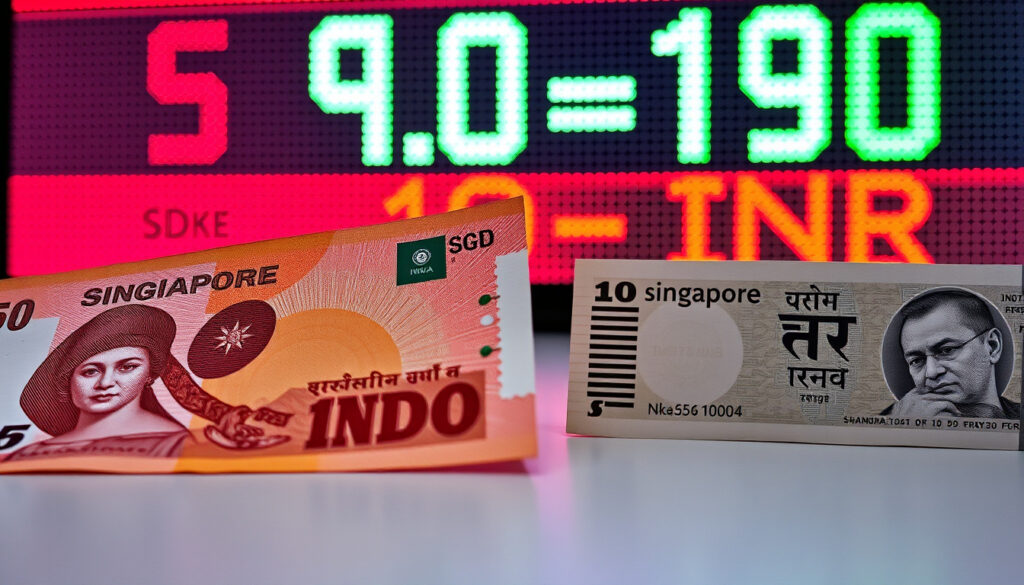
Exchange Rate Singapore to India: SGD to INR Guide
Anyone sending money from Singapore to India, planning a move, or just comparing gold prices has probably stared at the SGD–INR rate and wondered: is this number real, or are the banks eating my lunch? The short answer: the mid-market rate sits around 1 SGD to 72–74 INR depending on the day and the platform you use.
Mid-market rate (XE): 1 SGD = 72.13 INR ·
100 SGD: 7,213 INR ·
1,000 SGD: 72,133 INR ·
10,000 SGD: 721,334 INR
Quick snapshot
- Mid-market rate from Xe currency converter: 1 SGD = 72.1334 INR
- OFX live rate: 1 SGD = 74.1706 INR (OFX remittance service)
- Wise mid-market: 1 SGD = 72.91 INR (Wise rate history)
- 3,500 SGD ≈ 252,467 INR at XE mid-rate (XE converter)
- 7,000 SGD monthly is above Singapore’s median income (MOM labour statistics)
- 1,000 SGD ≈ 72,133 INR – livable in smaller Indian cities (Numbeo cost of living)
- Employment Pass application fee: SGD 105 (issued by MOM) (MOM visa fees)
- S Pass fee: SGD 100–200 depending on category (MOM S Pass)
- Medical check-up and renewal: SGD 50–100 extra (MOM health requirements)
- Singapore: no import duty on investment gold, GST-exempt (IRAS tax policy)
- India: 15% import duty + 3% GST on gold (CBIC customs)
- Difference can make gold 5–10% cheaper in Singapore (industry estimate) (IRAS tax policy)
| Amount (SGD) | Equivalent (INR) | Source |
|---|---|---|
| 1 SGD | 72.13 INR | XE |
| 100 SGD | 7,213 INR | XE |
| 1,000 SGD | 72,133 INR | XE |
| 10,000 SGD | 721,334 INR | XE |
| 3,500 SGD | 252,467 INR | XE |
The pattern is clear: the posted rate you see is not the rate you get. The real spread lies between mid-market platforms and bank counter rates.
How much is $1000 Singapore in Indian money?
At the mid-market rate from Xe currency converter, 1,000 Singapore dollars convert to about 72,133 Indian rupees. That’s the raw rate before bank fees or transfer margins. Most money-transfer services and banks add a spread — OFX remittance service, for instance, showed 74.17 INR per SGD on May 26, 2026, meaning 1,000 SGD would fetch roughly 74,171 INR — about 2,000 INR more. The difference comes from timing and the service’s markup.
How much is 100 SGD in INR?
100 SGD = 7,213 INR (mid-market via XE). Using the counter rate from SBI Singapore tier-1 bank, 100 SGD would get you about 7,355 INR at the 73.55 rate for bands up to 100,000 SGD.
How much is 10,000 SGD in INR?
10,000 SGD = 721,334 INR mid-market (XE). At the SBI counter rate of 73.55 for lower bands, you’d receive about 735,500 INR. For larger amounts (400,001–800,000 SGD), SBI offered 73.62 INR per SGD on May 29, 2026 (SBI Singapore).
How much is ₹1 of Singapore in India?
This question likely confuses “₹1 of Singapore” with 1 Singapore dollar (SGD). 1 SGD equals roughly 72–74 INR depending on the provider. If you meant ₹1 Indian rupee, the inverse is: 1 INR = 0.0138 SGD (mid-market). Use Wise live calculator for real-time inversion.
The implication: small differences in the exchange rate compound quickly for larger sums, making provider choice as important as the rate itself.
What is 3500 salary in Singapore in Indian rupees?
At the current XE mid-rate of 72.1334, a monthly salary of 3,500 SGD equals about 252,467 INR. That’s the gross amount — after Singapore’s low personal income tax (effective ~2–7% for this bracket) and before any transfer fees. Using the OFX rate, the same salary converts to roughly 259,597 INR monthly.
Is 7000 a month a good salary in Singapore?
According to the Ministry of Manpower (MOM official labour statistics), the median monthly salary for full-time employees in Singapore was about 5,700 SGD in 2025. A 7,000 SGD salary is roughly 23% above median — considered comfortable for a single person, especially if the employer provides housing allowance or medical benefits. At the mid-market rate, 7,000 SGD = 504,934 INR, which would be a very high income for most Indian professionals.
Can I live on $1000 a month in India?
1,000 SGD ≈ 72,133 INR. According to cost-of-living data compiled by Numbeo crowd-sourced living costs, a single person’s monthly expenses (rent, food, transport, utilities) in a city like Pune or Chennai average around 35,000–50,000 INR. So 72,133 INR is livable — but tight in Mumbai or Delhi where rent alone can exceed 30,000 INR. For a family, 72,133 INR would be barely enough in tier-2 cities.
A 3,500 SGD salary in Singapore buys a decent lifestyle due to low taxes and high wages. When remitted to India, it gives substantial purchasing power — but the conversion rate swings of up to 11% in 2025 (Exchange Rates UK 2025 data) mean timing matters for the Indian recipient.
How much is a 2 year work visa in Singapore?
Singapore’s Ministry of Manpower (MOM work passes) sets standard fees. For an Employment Pass (the most common professional visa), the application fee is SGD 105 per pass, with a one-time issuance fee of SGD 225 for passes approved after 31 December 2024. Total upfront cost: around SGD 330. The S Pass — for mid-skilled workers — costs SGD 100 (application) plus SGD 200 (issuance). Both passes are valid up to 2 years initially, with renewals costing similar amounts. The exchange rate volatility means the actual INR value can shift by thousands each month, so it’s wise to check the current Kanadan dollari euroksi kurssi.
What are the visa fees for Employment Pass in Singapore?
- Application fee: SGD 105 (non-refundable, per pass) — MOM Employment Pass fees
- Issuance fee: SGD 225 (payable after approval) — MOM fee schedule
- Medical examination: SGD 50–100 (if required) — MOM health requirements
- Total for 2-year EP: approximately SGD 330–400
Are there additional costs for visa renewal?
Renewal fees match the initial issuance: SGD 105 application + SGD 225 issuance = SGD 330 per renewal. Some employers cover these costs, so check your contract. Additional costs may include mandatory medical insurance and a security bond for certain nationalities, but these vary by case.
Visa fees are a fraction of relocation costs. For an Indian professional moving to Singapore, the bigger budget items are housing deposit (2–3 months rent, typically SGD 3,000–6,000) and the refundable MOM security bond (up to SGD 5,000 for some nationalities).
The catch: the SGD 330 visa fee is minor compared to the housing and bond costs that follow for most movers.
Is gold cheap in Singapore or India?
Gold prices in Singapore are generally lower because the country does not levy import duties on investment-grade gold and gold is GST-exempt (IRAS tax policy). India, on the other hand, imposes a 15% customs duty plus 3% GST on gold imports (CBIC Indian customs duty). Even after shipping and markup, Singapore gold rates are often 5–10% cheaper than Indian retail prices. However, specific live gold prices are not part of this dataset; for exact comparisons, check BullionStar Singapore gold dealer or the Indian Bullion and Jewellers Association.
What is the gold rate in Singapore today?
Live gold prices are not provided in this research. Use BullionStar Singapore or UOB precious metals for spot rates. As a rule of thumb, Singapore’s gold rate = international spot price (in USD) converted to SGD at current exchange rates, with no additional duties. India’s gold rate includes import duty and GST, making it costlier for the same purity.
Upsides
- Singapore: no import duty, GST-free, pure pricing
- Wide choice of certified dealers (BullionStar, UOB, Silver Bullion)
- Can buy and store tax-free for investment
Downsides
- India: 15% import duty + 3% GST immediately raises cost
- Banks in India charge a premium over spot for gold coins
- Carrying gold from Singapore to India: customs declaration required, 1 kg limit for NRIs
Even if gold is cheaper in Singapore, bringing it into India incurs customs duty of 15% on arrival — that wipes out the price advantage for personal imports. For investment, buying gold ETFs in Singapore and holding them offshore is the most tax-efficient route for an Indian buyer.
The implication: Singapore’s tax-free gold market offers a genuine price edge only if the gold stays outside India.
Confirmed facts vs. What’s unclear
Confirmed facts
- Mid-market SGD/INR rate from Xe: 1 SGD = 72.1334 INR as of May 26, 2026 (XE)
- SBI Singapore counter rate: 73.55 INR per SGD for amounts up to 100,000 SGD (May 29, 2026) (SBI Singapore)
- Average SGD/INR rate in 2025: 66.731 INR per SGD (Exchange Rates UK)
- Highest rate in 2025: 70.555 INR per SGD; lowest: 62.613 INR per SGD (Exchange Rates UK)
- Employment Pass application fee: SGD 105 (MOM)
What’s unclear
- Future exchange rate direction — the 2025 range (±11.6%) shows volatility (Exchange Rates UK)
- Exact visa fees for job categories not specified
- Current spot gold price in Singapore or India (not in provided research)
- Bank transfer fees and margins at the time of actual transaction
For those tracking remittances or travel budgets, the latest SGD to INR rate provides a live comparison of provider spreads and mid-market benchmarks.
Frequently asked questions
How often does the SGD to INR exchange rate change?
It changes continuously — every few seconds during market hours. The mid-market rate updates in real-time on platforms like XE and Wise. For practical purposes, check the rate at the moment you initiate a transfer.
What is the best time of day to convert SGD to INR?
There’s no consistent best time. The SGD/INR pair trades 24/5. Some studies suggest early Asian trading hours (8–10 AM SGT) offer tighter spreads, but the difference is usually negligible for retail conversions.
Can I use Indian rupees in Singapore?
No — Singapore only accepts SGD. You must exchange to SGD at money changers, banks, or ATMs. Some shops in Little India may accept INR at poor rates, but it’s not recommended.
Do I need to pay tax when converting SGD to INR?
No conversion tax in either country. However, if you are a tax resident in Singapore or India, the gain from currency fluctuation may be subject to capital gains tax in rare cases. For personal remittances, no tax applies.
How much is 1 velli in Indian rupees?
“Velli” is a Tamil term for gold (or silver). It is not a currency unit. If you mean 1 sovereign of gold (8 grams), its value depends on the gold rate. As of the absence of gold price data in this research, check local jewellers.
Is it better to exchange money in Singapore or India?
Generally, you get a better rate in Singapore — money changers in Little India offer competitive rates with no commission. In India, authorised dealers and banks add a spread. For large amounts, use Wise or OFX for mid-market rates.
What is the current exchange rate from SGD to INR?
The latest mid-market rate from Xe is 1 SGD = 72.1334 INR (XE). For other providers, see the snapshot at the top of this article.
How do I convert Singapore dollars to Indian rupees?
Use a currency converter like XE, Wise, or BookMyForex. To execute a transfer, use Wise (mid-market + low fee), OFX (fixed rate), or SBI Singapore (bank counter rate). Compare all three before sending.
The SGD–INR exchange rate is currently in a zone where the Singapore dollar has strengthened significantly — up 11.6% in 2025 alone. For the Indian expat sending money home or the traveller planning a trip, the implication is clear: lock in a rate when you see a good mid-market offer, avoid airport counters, and always check at least two sources before transferring. For gold buyers, Singapore’s tax-free market offers a genuine price edge — but only if you can keep the gold outside India, or the customs duty eliminates the advantage for anyone bringing it into India.
More related posts
 Kopi C Siew Dai: Meaning, Taste, and How to Order in Singapore
 URA HDB Singapore Land Sales: Government Land Sales Guide
 Private Swimming Lessons Singapore: Cost & Worth (2026)
 When Is Mother’s Day in Ireland? 2026 & 2027 Dates
 iPhone 16 Pro Max Price in Ireland: Specs & Guide 2025
 12 Days of Christmas Lyrics: Meaning, History & 364 Gifts
 Lendlease Global Commercial REIT: Why It Dropped and What’s Next
 Ne Zha 2 Videos: Where to Watch, Release Date & English Dub
