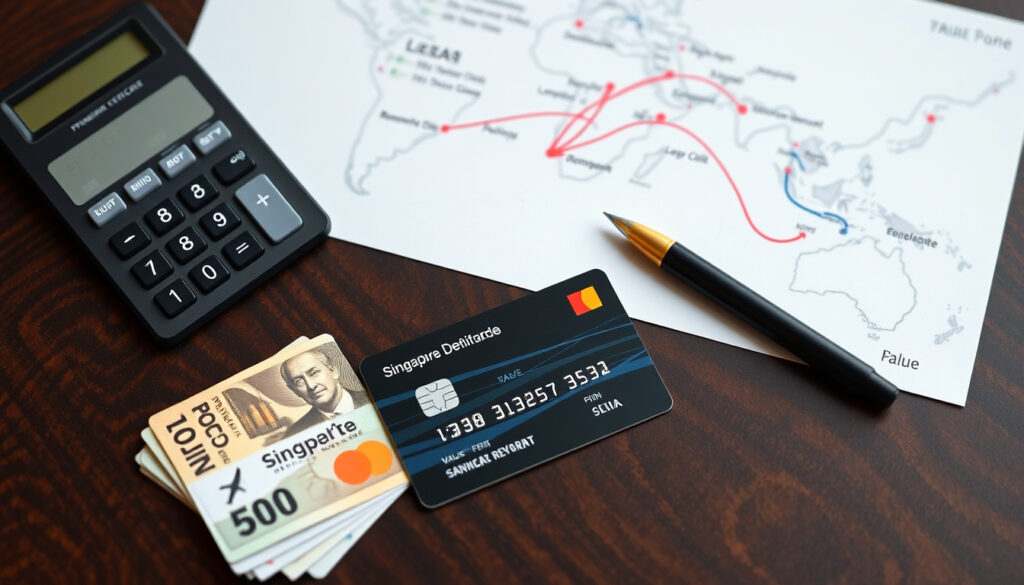
Best Miles Credit Card Singapore: Don’t Just Chase Earn Rates
Anyone who’s ever tried to pick a miles credit card in Singapore knows the feeling: you’re staring at a spreadsheet of earn rates, welcome bonuses, and annual fees, and somehow it still isn’t clear which one actually puts you ahead. The truth is, the best card for you depends less on the highest headline earn rate and more on how you spend, how often you redeem, and what hidden costs chip away at your miles.
For example, a mile’s value can range from S$0.01 to S$0.02 when used for flights (MoneySmart (Singapore credit card comparison platform)), but retail redemptions often cut that in half. The right card for your wallet depends on a handful of trade-offs — once you see them clearly, the best choice becomes obvious.
Typical miles earn rate on local spend: 1.3 to 2.2 miles per dollar ·
Highest welcome bonus currently available: Up to 35,000 miles on first spend ·
Miles needed for Singapore Airlines economy return to Tokyo: Approximately 40,000 miles ·
Annual fee range for top miles cards in Singapore: S$0 to S$300 (first year often waived)
Quick snapshot
- DBS Altitude, Citi PremierMiles, and OCBC 90°N are among the top miles cards for local spend (DiveDeals (Singapore credit card comparison site))
- KrisFlyer miles redeemed for economy flights typically return S$0.01–S$0.02 per mile (MoneySmart) (DiveDeals (Singapore credit card comparison site))
- Welcome bonuses are time-limited and vary by promotion cycle (MoneySmart) (DiveDeals (Singapore credit card comparison site))
- How much airlines will devalue miles in future award charts
- Which bank will offer the highest sign-up bonus next quarter
- DBS Altitude’s S$25,000 annual fee waiver condition expires end of August 2026 (You.co (personal finance comparison site))
- Standard Chartered promotion offering S$180 cashback + 20,000 miles ends soon (MoneySmart) (You.co (personal finance comparison site))
- Banks may launch new miles cards with higher earn rates to compete
- KrisFlyer could adjust award pricing as fuel surcharges evolve
Five key numbers that define the Singapore miles card market:
| Metric | Value |
|---|---|
| Average earn rate (local spend) | 1.2 – 1.5 miles per dollar |
| Average earn rate (overseas spend) | 2.0 – 2.5 miles per dollar |
| Typical miles valuation | 1.5 – 2.0 cents per mile for economy, 2.5 – 4.0 for business |
| Most common welcome bonus | 25,000 – 35,000 miles after S$500–S$1,000 spend |
| Annual fee range (first year waived) | S$0 – S$300 |
What is the best credit card for miles in Singapore?
The short answer: it depends on your spending. But three cards consistently top the comparison tables.
Which credit card is best for airline miles?
- DBS Altitude Visa Signature: 1.3 miles per dollar (MPD) on local spend, 2.2 MPD overseas. Welcome bonus up to 35,000 miles. No foreign transaction fee. Annual fee S$196.20, waived if you spend S$25,000 per year (expires Aug 2026) (You.co)
- Citi PremierMiles Card: 2 MPD on all spend. Welcome bonus up to 30,000 miles. Complimentary travel insurance and lounge access. Annual fee S$196.20, first year free.
- OCBC 90°N Card: 1.2 MPD local, 2.3 MPD on travel and dining. No annual fee for first year, minimal thereafter. Transfers to KrisFlyer and other partners.
Cards with high headline earn rates like 4 MPD often cap bonus earnings at S$1,000 per month and apply only to specific categories (DiveDeals). For most Singaporeans, a steady 1.2–1.5 MPD on all spend beats a volatile 4 MPD that resets every month.
Which Singapore credit card is best for travel?
- Citi PremierMiles: includes complimentary travel insurance and Priority Pass lounge access (2 visits per year)
- DBS Altitude: offers travel insurance and lounge access, plus no foreign transaction fee
- HSBC TravelOne: direct KrisFlyer earner, no conversion fees (DiveDeals)
The implication: the best travel card for you depends on whether you value lounge access, fee-free overseas spending, or direct miles transfer. None of the top cards excels at all three. After comparing the top contenders, the pattern is clear: no single card wins every category. The right choice balances your top spend categories with the fees you’re willing to pay.
TL;DR: DBS Altitude, Citi PremierMiles, and OCBC 90°N lead in different areas; pick based on your spend profile and fee tolerance.
How much is 50,000 KrisFlyer miles worth?
50,000 KrisFlyer miles can be worth anywhere from S$500 to S$2,000 depending on whether you redeem for economy or business class (Pelago (Singapore travel booking platform)).
The value per mile depends entirely on the redemption type. Below is a typical range:
| Redemption type | Value per mile | 50,000 miles value |
|---|---|---|
| Economy saver award | 1.5 – 2.0 cents | S$750 – S$1,000 |
| Business class award | 2.5 – 4.0 cents | S$1,250 – S$2,000 |
| Retail/gift cards | ~1.0 cent | S$500 |
How much is 10,000 KrisFlyer miles worth?
At the same valuations, 10,000 miles is worth roughly S$100–S$200 for flights or about S$100 for retail. The key: never redeem miles for retail unless you’re topping up a small balance — you lose at least half the value. What this means: a mile’s value is not fixed. The card that earns 2 MPD on business class redemptions is worth more than a card earning 2.5 MPD if you only ever fly economy.
TL;DR: Maximize value by redeeming for business class long-haul; avoid retail redemptions that cut value to ~1 cent per mile.
What credit card gives you KrisFlyer miles?
Which credit cards earn KrisFlyer miles directly?
- HSBC TravelOne – miles post directly to KrisFlyer (DiveDeals)
- KrisFlyer UOB Credit Card – co-branded card, direct earn
- Kris+ app – instant conversion of Citi, DBS and UOB points without fees (The MileLion)
Conversion fees can eat into your miles. The MileLion (a Singapore miles strategy blog) reports most banks charge around S$25 per conversion, though cards like HSBC TravelOne and those using Kris+ may offer free transfers (The MileLion).
Co-branded vs general miles cards
- Co-branded (e.g. KrisFlyer UOB): miles go directly to KrisFlyer, no transfer steps. Limited to one airline program.
- General miles cards (e.g. DBS Altitude, Citi PremierMiles): earn bank points that can be transferred to KrisFlyer and other partners (Asia Miles, etc.). More flexibility but conversion fees and minimum block sizes apply.
The trade-off: co-branded cards offer convenience and direct earning, but general miles cards give you flexibility to transfer to multiple programs — a safety net if you switch airlines.
TL;DR: Co-branded cards simplify earning but lock you into one program; general miles cards offer flexibility at the cost of conversion fees.
How many miles are needed for a free flight with Singapore Airlines?
Mileage required for popular routes
Saver award rates for three common routes from Singapore:
| Route | Economy Saver (miles) | Business Saver (miles) |
|---|---|---|
| Singapore – Bangkok | 15,000 | 35,000 |
| Singapore – Tokyo | 40,000 | 85,000 |
| Singapore – London | 60,000 | 120,000 |
These are saver awards; standard awards require more miles. Peak season pricing can increase by 20–30%. The pattern: business class costs roughly double the miles of economy, yet the cash price difference is often three to four times — making business class the better miles value per dollar.
TL;DR: Business class redemptions deliver better value per mile; save miles for long-haul routes like London or Tokyo.
Is it better to pay with miles or cash?
Using miles for a cheap regional flight when the cash fare is S$100 is wasteful — you’d get far less than 2 cents per mile. Save miles for long-haul business class tickets where cash fares exceed S$3,000 (Pelago).
When to use miles vs cash for flights
- Use miles when the cash fare is high relative to miles spent (e.g., business class long-haul)
- Use cash when the fare is low (short-haul economy) — you’ll also earn new miles on the purchase
- Consider that paying with cash earns you new miles, so the opportunity cost is real
Opportunity cost of miles
Cash spent on flights could have been invested or spent elsewhere. Miles locked in KrisFlyer devalue if not used for a few years. According to MoneySmart, “air miles are typically best redeemed for flights”. The decision rule: use cash when the fare is below S$0.02 per mile on the miles you’d spend; use miles when the fare is higher.
TL;DR: Reserve miles for high-cash-value tickets (business class long-haul); use cash for cheap short-haul to earn new miles.
What is the most prestigious credit card in Singapore?
What is the hardest credit card to get in Singapore?
- American Express Centurion – invite-only, no public application
- UOB Reserve – reported minimum income of S$250,000 (not verified by our sources)
- Citi Ultima – reportedly requires S$200,000 annual income
The cards above are not widely covered by comparison platforms like MoneySmart or You.co because they are not mass-market products. For most Singaporeans, the hardest card to get among those that actually earn miles is the DBS Altitude or Citi PremierMiles, both of which require a minimum annual income of S$30,000 and a good credit score (MoneySmart).
TL;DR: High-end cards like Amex Centurion are out of reach for most; focus on accessible miles cards like DBS Altitude.
Head-to-head comparison
Three cards, one pattern: the best earn rate doesn’t always mean the best net value once fees are factored in.
| Feature | DBS Altitude | Citi PremierMiles | OCBC 90°N |
|---|---|---|---|
| Local earn rate | 1.3 MPD | 2 MPD | 1.2 MPD (2.3 on travel/dining) |
| Overseas earn rate | 2.2 MPD | 2 MPD | 2.3 MPD (on travel) |
| Welcome bonus | Up to 35,000 miles | Up to 30,000 miles | Up to 25,000 miles |
| Annual fee | S$196.20 (waived with S$25,000 spend) | S$196.20 (first year free) | S$0 first year, then S$150 |
| Foreign transaction fee | 0% | 3.25% (most cards) | 3.25% |
Sources: MoneySmart, DiveDeals, You.co, The MileLion.
The implication: the head-to-head shows that no single card dominates; the choice depends on spend habits and fee tolerance.
TL;DR: DBS Altitude wins on no foreign transaction fee; Citi PremierMiles offers highest flat earn rate; OCBC 90°N excels on travel/dining.
Pros and cons of miles credit cards in Singapore
Upsides
- Effective earn rates of up to 4 MPD on category spending (DiveDeals)
- Welcome bonuses of 25,000–35,000 miles can subsidize a short-haul flight
- No annual fee in first year on many cards
- Direct KrisFlyer earning eliminates conversion fees on some cards (The MileLion)
Downsides
- Conversion fees average S$25 per transfer (The MileLion)
- Foreign transaction fees of 3.25% on most cards (You.co)
- Spend caps on bonus earn rates (e.g., S$1,000/month for 4 MPD cards) (DiveDeals)
- Miles expire after 3 years of inactivity in KrisFlyer
The balance: the upsides of miles cards can outweigh the downsides for frequent travelers, but casual users may lose value through fees and expiry.
TL;DR: Miles cards reward loyal flyers but require careful management of fees, caps, and expiry.
What’s clear and what’s not about miles credit cards in Singapore
Confirmed facts
- DBS Altitude, Citi PremierMiles, and OCBC 90°N are top miles cards in Singapore (DiveDeals)
- KrisFlyer miles valued at 1.5–2 cents each for economy awards (MoneySmart)
- Welcome bonuses fluctuate and are time-limited (MoneySmart)
What remains unclear
- Exact future value of miles due to airline devaluations
- Which card will offer the highest bonus in next quarter
The key: stick with confirmed facts and plan for uncertainty.
Expert perspectives on miles strategy
“The best miles card isn’t the one with the highest earn rate — it’s the one whose annual fee structure and conversion terms align with your redemption frequency.”
— MoneySmart editorial team (MoneySmart)
“Most people leave value on the table by redeeming miles for retail vouchers. If you’re willing to plan ahead and book saver awards, you can easily triple the value per mile.”
— Founder of The MileLion (The MileLion)
For the average Singaporean earning S$60,000 a year, the choice is clear: go with a no-annual-fee card for the first year, focus on category bonuses, and save miles for long-haul business redemptions. Anything else leaves both miles and cash on the table.
Related reading: Singapore to Bangkok Flights: Time, Cost & Essential Tips
suitesmile.com, pointhacks.com.au, wise.com, youtube.com, singsaver.com.sg, tiktok.com, americanexpress.com
Frequently asked questions
Can I transfer miles from my credit card to another frequent flyer program besides KrisFlyer?
Yes. General miles cards like DBS Altitude and Citi PremierMiles allow transfers to multiple airline partners including Asia Miles, British Airways Executive Club, and others. Each transfer incurs a fee (typically S$25 per conversion). Check with your bank for current partner lists (The MileLion).
How long do KrisFlyer miles expire?
KrisFlyer miles expire after three years if there is no qualifying activity on your account. A qualifying activity includes earning miles from flights, credit card spend, or partners, or redeeming miles. To keep your miles alive, ensure you earn or use at least one mile every three years (Pelago).
Do miles credit cards in Singapore have foreign transaction fees?
Most miles cards in Singapore charge a 3.25% foreign transaction fee on overseas purchases. An exception is the DBS Altitude Visa Signature, which charges 0% foreign transaction fee (You.co).
What is the minimum income requirement for a miles credit card in Singapore?
The typical minimum annual income for a miles credit card is S$30,000. Some premium cards like the UOB Reserve may require S$120,000 or more. Check with the issuing bank for current standards (MoneySmart).
Can I pool miles with family members?
KrisFlyer does not officially allow pooling of miles across accounts. However, you can transfer miles between KrisFlyer members for a fee (S$25 per transfer) up to a limit per year. Alternatively, you can use the KrisFlyer Redemption for Others feature to book tickets for family using your miles.
Is there a cap on the number of miles I can earn per month?
Some cards impose caps on bonus earn rates. For example, cards offering 4 MPD on categories may cap bonus miles at S$1,000 of spend per month. Always check the terms for each card (DiveDeals).
More related posts
 Convert Excel to PDF: Free Tools & Step-by-Step Guide
 Motorcycle Shop Near Me: Best Dealers Dublin & Cork 2025
 K-League XI vs Newcastle: 1-0 Result, Lineups & Report
 Schneider Electric Share Price: Buy, Sell, Hold? (2026)
 Lets Post It Porn – Research Findings and Safety Guide
 Lee Na-young: Biography, Marriage, Kids, and Why She Left Acting
 Singapore to Genting Highlands: Bus Time, Cost, How to Get
 TIT FOR TAT Lyrics Meaning: Tate McRae’s Song Explained (2025)
