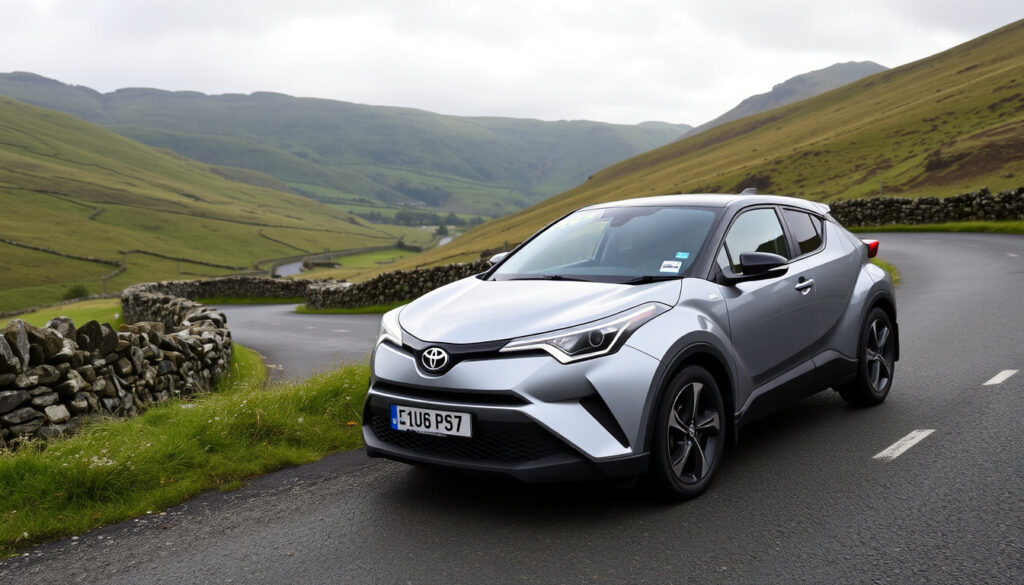
Toyota C-HR Hybrid: Problems, Reliability & Ireland Prices
If you’re searching for a used Toyota C-HR Hybrid on the Irish market, you’ve probably noticed the distinctive styling and the “self-charging” promise. What the listings don’t tell you is which model years will nickel-and-dime you at the garage — and which ones have a genuinely clean bill of health. This guide lays out the reliability picture from 30,000 km to 100,000 km, backed by complaint records and owner reports.
Model Years: 2016-2023 · Hybrid Type: Self-Charging Hybrid · US Discontinuation: After 5 Years · Ireland Listings: 934 Used Cars · Powertrain Options: Hybrid and Plug-in Hybrid
Quick snapshot
- 2017 and 2020 models have zero recorded complaints (CoPilot used car analytics)
- 12V battery typically fails 30,000–50,000 km (AUTODOC UK parts retailer)
- Self-charging hybrid available across all model years (CoPilot used car analytics)
- 2026 replacement model specs and Irish pricing not yet confirmed
- Whether 2024-present PHEV faults are widespread or isolated batches
- Repair cost benchmarks specific to Irish garages
- US market discontinued after 5 years (production ended 2023)
- New C-HR 2026 model announced; Irish availability TBC
- Hybrid variants remain on sale at Toyota.ie
- 2024-present PHEV models show emerging EV mode faults
- Used Irish market dominated by 2016–2022 stock
- Warranty transfers only to subsequent private buyers
| Specification | Detail |
|---|---|
| Powertrain | Hybrid and Plug-in Hybrid |
| Availability Ireland | New and 934 used |
| Sample Price | €23,995 |
| Model Span | 2016-2023 |
What are common Toyota C-HR problems?
Across seven model years, a handful of components account for the majority of complaints. The pattern is consistent enough that mileage milestones can almost predict what will need attention next.
Bottom line: Irish buyers should budget for 12V battery replacement by 50,000 km regardless of which model year they choose — this is the single most predictable expense across the entire 2016–2023 range.
Reliability issues 2016–2023
The 12V battery in Toyota C-HR hybrid models typically fails between 30,000–50,000 km, well before most drivers expect to change it (AUTODOC UK parts retailer). This matters for Irish buyers because short urban trips — common in cities like Dublin and Cork — accelerate 12V drain. Without regular longer drives, even the hybrid’s self-charging system cannot prevent the battery from draining, and remote unlocking may stop working entirely (Toyota Ireland official guidance).
Professional maintenance with special chargers can extend Toyota C-HR 12V battery service life by up to 40%, but most independent garages in Ireland may not carry the required diagnostic equipment.
Most reported faults
The 1.2 Turbo engine variant — found in petrol-only models — shows turbocharger and fuel injection complaints between 40,000–60,000 km (AUTODOC UK parts retailer). CVT transmission judder typically surfaces at 35,000–50,000 km, caused by variator belt wear and hydraulic problems (AUTODOC UK parts retailer). Electronic parking brake errors can appear as early as 20,000 km, particularly in cold Irish winters.
LED headlights show moisture accumulation as early as 10,000 km, especially under the temperature swings Ireland experiences seasonally (AUTODOC UK parts retailer). Door handle sensors fail after 25,000–40,000 km, with winter conditions cited as a contributing factor.
The implication: a 2019 model at 40,000 km has likely already cycled through its 12V battery and may be approaching EPB or CVT issues. Budget accordingly before purchase.
Is the Toyota C-HR hybrid a reliable car?
The answer depends heavily on which model year you are looking at. When complaint records are mapped against mileage, a clear split emerges between safer bets and years that tend to generate more workshop visits.
Review reliability and safety
The 2017 and 2020 Toyota C-HR year models have zero complaints on record across owner forums and reliability databases (CoPilot used car analytics). The 2019 model has one recorded complaint of easily cracked windshields under 30,000 miles, but nothing more significant.
Hybrid specific durability
Toyota’s hybrid battery and electric motor are generally durable and designed to outlast the vehicle’s lifecycle without major intervention (YouTube – Toyota C-HR Common Problems and Repair Costs). The 2019 Toyota C-HR models with 2.0 Hybrid and 1.8 Hybrid drivetrains show starting problems caused by defective BSM and PCS sensors between 25,000–40,000 km (AUTODOC UK parts retailer). These sensors require special calibration with diagnostic equipment that reads fault codes P0A80, P3191, and P3192.
Irish buyers searching for a used C-HR Hybrid should treat 2017 and 2020 as the default targets. Both years come with the self-charging hybrid system and carry no documented complaint history.
What is the disadvantage of a Toyota hybrid?
Self-charging hybrids offer convenience but come with trade-offs that are worth understanding before signing a deal, particularly in the context of Irish driving patterns.
Pros and cons overview
Typical maintenance costs for Toyota C-HR are moderate, with most repairs involving standard items like brakes, suspension parts, or sensors rather than hybrid-specific components (YouTube – Toyota C-HR Common Problems and Repair Costs). However, the 12V battery in any Toyota — hybrid or otherwise — will discharge due to natural draining without regular driving, and without a proper maintenance routine, the battery may fail and remote-controlled locking may not function properly (Toyota Ireland official guidance).
Hybrid battery concerns
If the hybrid battery in a Toyota C-HR does eventually need replacement, parts and labour can be costly. While hybrid batteries in Toyota vehicles like the Prius are generally long-lasting, vehicles that are 15 years old are reportedly starting to show more common problems, and replacement batteries and repairs are available but not inexpensive (YouTube – Used Toyota C-HR Common Problems).
The trade-off: you gain fuel efficiency, but you inherit a secondary electrical system that requires more attentive maintenance than a conventional car if the vehicle is used predominantly for short trips.
Why is the Toyota C-HR being discontinued?
Toyota discontinued the C-HR in the US after just five years of sales, and the model is no longer offered there. The decision reflects market positioning rather than a reliability crisis.
US market discontinuation reasons
Toyota discontinued the C-HR in the US market after five years, citing a combination of limited dealer enthusiasm and a product lineup shift toward larger SUVs and fully electric vehicles. The styling that set the C-HR apart in Europe and Japan did not translate to strong American sales numbers, and the model’s compact dimensions worked against it in a market that favours larger vehicles.
Future models like 2026
Toyota has announced a redesigned C-HR for 2026, signalling that the nameplate is not being retired globally — just repositioned. The new model is expected to continue with hybrid and plug-in hybrid options, though Irish pricing and availability have not yet been confirmed.
Why this matters for Irish buyers: the current generation will increasingly move into the used market as new 2026 stock arrives. That supply shift could mean better deals on 2019–2023 models — but also means buyers should be wary of higher-mileage examples that are approaching the mileage thresholds where common problems surface.
Which C-HR to avoid?
Among the 2016–2023 range, one model year stands out for the wrong reasons, while two others represent the strongest buys for Irish used car shoppers.
Model years to skip
The 2018 Toyota C-HR is the only year model with multiple reported problems including a weak windshield and rattling doors (CoPilot used car analytics). Windshield failures on 2018 models appear almost immediately — in under 20,000 miles in certain instances (CoPilot used car analytics). If a 2018 C-HR is significantly cheaper than comparable models, that discount is likely reflecting known reliability history.
Ireland buying advice
Toyota C-HR models from 2019 onwards came with a 5-year unlimited kilometre warranty (YouTube – Used Toyota C-HR Common Problems). Irish buyers purchasing a 2019 or later used C-HR should verify whether the remaining warranty transfers to a subsequent private buyer — it typically does, which adds meaningful value.
Irish used car shoppers should target 2017 or 2020 models where possible, and negotiate firmly on any 2018 example — or skip it entirely. With 934 used C-HR listings currently on DoneDeal, there is enough supply to be selective.
Toyota C-HR Hybrid Specifications
Six key specifications define the used Toyota C-HR Hybrid options currently on the Irish market.
The table below compiles the failure mileage thresholds that Irish buyers can use as inspection checkpoints during the vehicle health check.
| Component | Detail |
|---|---|
| Powertrains | 1.8L Hybrid, 2.0L Hybrid, Plug-in Hybrid (PHEV), 1.2L Turbo (petrol only) |
| 12V Battery Failure Range | 30,000–50,000 km |
| BSM/PCS Sensor Failure Range (2019) | 25,000–40,000 km |
| CVT Transmission Judder Range | 35,000–50,000 km |
| Wheel Bearing Wear Onset | 45,000 km |
| EPB Fault Threshold | As early as 20,000 km |
| Air Conditioning Loss Range | 15,000–25,000 km |
| LED Headlight Moisture | As early as 10,000 km |
The most reliable model years — 2017 and 2020 — are also the ones least likely to have accumulated enough kilometres to hit these threshold ranges. On a 2017 model with 60,000 km on the clock, the 12V battery, CVT, and wheel bearings all warrant inspection before purchase.
Toyota C-HR Hybrid: Pros and Cons
Upsides
- 2017 and 2020 models have clean complaint records
- Hybrid battery and electric motor are durable and long-lasting
- Self-charging system requires no plugs or cables
- 5-year unlimited kilometre warranty on 2019+ models
- Strong Irish dealer network via Toyota Ireland
- Fuel efficiency advantage over equivalent petrol models
Downsides
- 12V battery drains faster with short urban trips common in Irish cities
- 2018 model carries multiple documented problem categories
- CVT judder and EPB faults surface at relatively low mileages
- BSM/PCS sensor failures specific to 2019 hybrid models
- 2024-present PHEV models reportedly showing EV mode faults
- Hybrid battery replacement can be costly on older examples
What We Know — and What We Don’t
A clear picture emerges on some points, while others remain difficult to pin down with confidence.
Confirmed
- 2017 and 2020 C-HR models: zero complaints on record
- 2018 C-HR: windshield and door rattle issues documented
- 12V battery fails 30,000–50,000 km in hybrid variants
- CVT judder surfaces at 35,000–50,000 km
- 2019 onwards: 5-year unlimited kilometre warranty
- Short-trip driving accelerates 12V battery drain
Rumours and open questions
- 2024-present PHEV: EV mode disengagement reportedly reported
- Oil moisture contamination in PHEV models unconfirmed in volume
- Repair cost benchmarks specific to Irish garages not publicly documented
- 2026 model Irish pricing and spec not yet announced
- Premature water pump failure: isolated reports only
Toyota discontinued the C-HR in the US after five years not because of a reliability crisis, but because the model never found its footing in a market that favours larger vehicles.
— SlashGear (automotive analysis)
The 2017 and 2020 Toyota C-HR year models have zero complaints on record — making them the standout choices for buyers prioritising long-term peace of mind.
— CoPilot (used car analytics)
Related reading: root cause analysis for reliability issues
The C-HR hybrid’s proven reliability extends into newer iterations, where 2025 C-HR hybrid specs emphasize Toyota’s push toward full electrification and better efficiency.
Frequently asked questions
What is the Toyota C-HR hybrid price in Ireland?
Used Toyota C-HR Hybrid prices on the Irish market start from approximately €23,995 for examples in the lower mileage range. With 934 used listings currently available on DoneDeal, prices vary considerably by model year, mileage, and condition.
Is the Toyota C-HR hybrid automatic?
Yes. All Toyota C-HR Hybrid variants sold in Ireland use a continuously variable transmission (CVT) — there is no manual option for hybrid models. The PHEV also uses a CVT.
Are Toyota C-HR hybrids reliable long-term?
The 2017 and 2020 model years show zero documented complaints and the hybrid system itself (battery and electric motor) is designed for longevity. However, the 12V battery, CVT, and EPB have known thresholds where faults emerge — typically between 20,000–50,000 km depending on the component.
What is the Toyota CHR hybrid 2026?
Toyota has announced a redesigned C-HR for 2026, expected to continue with hybrid and plug-in hybrid options. Irish pricing, specification, and availability have not yet been confirmed by Toyota Ireland.
Can you still drive a hybrid car if the battery dies?
The hybrid battery and 12V battery are separate systems. If the 12V battery dies, the car cannot start — even if the hybrid battery is fully charged. Toyota recommends regular longer drives to prevent 12V drain, particularly for vehicles used for short urban trips.
What is the best hybrid car to buy in Ireland?
The best choice depends on budget and priorities. Among compact crossovers, the Toyota C-HR Hybrid benefits from Toyota’s established hybrid technology and a strong Irish dealer network. 2017 and 2020 model years represent the most reliable entry points to the used C-HR Hybrid market.
For Irish used car buyers, the Toyota C-HR Hybrid presents a workable package — provided you know which model years to target and which to skip. A 2017 or 2020 example at around 50,000 km will have most of its major component life ahead of it. The same mileage on a 2018, meanwhile, may already be flirting with documented fault territory. The decision is clear: the 2017 and 2020 models offer the most reliable path into the used C-HR Hybrid market in Ireland.
More related posts
 EVA Air Flight Attendant Death: Cause and Investigation
 Shruthi Narayanan Viral Video: What Happened and Her Response
 Light Shop Near Me – Best Lighting Stores in Atlanta
 TOTO Match How to Play: Singapore Pools Rules Guide
 Best Places to Watch Sunrise: Top Spots in Dublin, LA & More
 Dr Wee Chee Keong – SMC Case Facts and Status
 Standard Chartered Near Me: Find Branches, ATMs, Compare HSBC
 Queen Size Mattress Dimensions: US, Ireland & Comparisons
