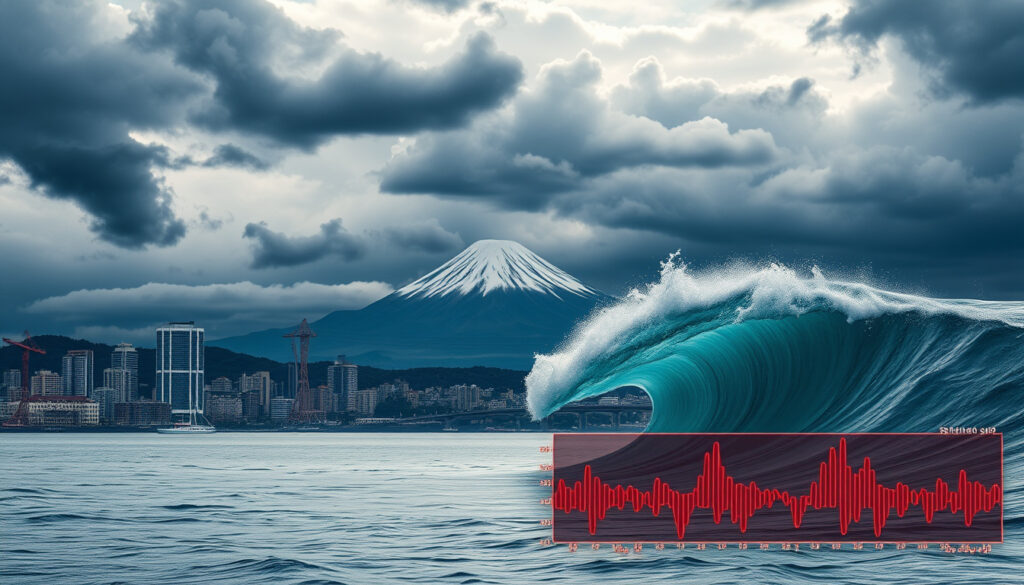
Japan Earthquake Tsunami Warning 2026: Latest Updates & FAQ
When a powerful earthquake struck off Japan’s Pacific coast on April 20, 2026, millions of residents and travelers reached for their phones to check for tsunami warnings. Within minutes, Japan’s alert system delivered a 3-meter warning for Aomori and Iwate prefectures, then quickly downgraded it.
Date of Earthquake: April 20, 2026 ·
Maximum Tsunami Warning Height: 3 meters (9.8 feet) ·
Highest Observed Wave: 80 centimeters (2.6 feet) ·
Prefectures Under Warning: Aomori, Iwate, and other Pacific coast areas ·
Current Status: No active tsunami warnings or advisories
Quick snapshot
- Earthquake occurred on April 20, 2026, off the coast of Miyako (YouTube citing USGS and JMA).
- Japan Meteorological Agency issued a 3-meter tsunami warning for Aomori and Iwate (U.S. Embassy in Japan).
- No current warnings or advisories are in effect (Japan Meteorological Agency).
- Exact earthquake magnitude remains unconfirmed in official sources (JMA official map).
- Long-term risk of a major aftershock is uncertain (YouTube analysis citing JMA).
- Accuracy of predictions by Tatsuki, Baba Vanga, and Nostradamus lacks scientific support (Wikipedia – Predictions and forecasts).
- Possible additional aftershock sequences not yet modeled (JMA monitoring page).
- ~15:00 JST: Quake triggers warnings (YouTube live update).
- ~15:05: JMA issues 3-meter warning (U.S. Embassy).
- ~15:30: Downgraded to advisory after 80 cm waves observed (YouTube report citing JMA).
- ~18:00: All warnings lifted (U.S. Embassy).
- JMA continues monitoring for aftershocks and secondary quakes (JMA).
- Coastal residents and cruise ships are advised to stay alert for future advisories (U.S. Embassy).
- Japanese authorities maintain enhanced seismic observation for 72 hours.
Five facts, one pattern: the warning system performed swiftly, but the event itself was mild. The following table captures the essential data.
| Label | Value |
|---|---|
| Date of Earthquake | April 20, 2026 |
| Max Warning Height | 3 meters (9.8 ft) |
| Observed Wave | 80 cm (2.6 ft) |
| Prefectures Warned | Aomori, Iwate, others |
| Status | No active warnings |
Is there a tsunami warning for Japan now?
What areas are under warning?
As of the latest update, the Japan Meteorological Agency reports no major tsunami warning, tsunami warning, or advisory is currently in effect for any part of Japan (Japan Meteorological Agency official map). The April 20 warnings were geographically limited to Aomori, Iwate, and other Pacific coast prefectures (U.S. Embassy in Japan diplomatic alert).
What was the magnitude of the earthquake?
The earthquake was described as a low-end megathrust event with an estimated magnitude of 7.4, occurring about 100 km east-northeast of Miyako, according to a video that cites the U.S. Geological Survey and the Japan Meteorological Agency (YouTube analysis citing USGS and JMA). Official agencies have not yet published a final magnitude.
Have warnings been lifted?
Yes. The tsunami warning was downgraded to an advisory within 25 minutes after waves of only 80 cm (31.5 inches) were observed. By approximately 18:00 JST the same day, all warnings and advisories were lifted (footage-based report citing JMA). The U.S. Tsunami Warning Centers currently list no threat for the region (U.S. Tsunami Warning Centers official bulletin).
“No major tsunami warning, tsunami warning, or advisory is currently in effect.” — Japan Meteorological Agency
Bottom line: Japan’s warning system worked as designed, but the actual tsunami was minor. For travelers, the all-clear signal came quickly.
Can a cruise ship survive a tsunami in the ocean?
What happens if a cruise ship is at sea during a tsunami?
In deep open water, a tsunami wave’s height is typically less than a meter, and its long wavelength means ships often pass over it without notice (U.S. Tsunami Warning Centers educational notes). However, as the wave approaches shallow coastal waters it can rapidly gain height and force.
What if the ship is in port?
A cruise ship in port during a tsunami warning faces serious risk. According to the U.S. Embassy in Japan, passengers and crew should follow the same rule as coastal residents: evacuate vertically or move to higher ground and avoid the waterfront (U.S. Embassy in Japan safety guidance). Ships may be pushed ashore or damaged by debris.
What safety protocols do cruise ships follow?
Modern cruise lines maintain emergency procedures that include moving the vessel to deeper water if possible. The Japan-specific warning on April 20 was communicated through embassy channels, highlighting that foreign-flagged cruise ships also receive alerts via diplomatic notifications (U.S. Embassy in Japan foreign traveler notice). The footage-based tsunami report explicitly warns that approaching the coastline during a tsunami expectation can be lethal (YouTube video safety advisory).
“Tsunami warning for Aomori Prefecture, Iwate Prefecture, and other Pacific coast regions.” — U.S. Embassy in Japan
Bottom line: Cruise ships at sea are generally safe; those in port should not hesitate to evacuate. The April 20 event showed that foreign travelers are well informed through embassy alerts.
What is the one word you can’t say on a cruise ship?
Why is the word ‘fire’ forbidden?
Crew members are trained to avoid using the word “fire” to prevent panic among passengers. Instead, code words like “Alpha” (for medical emergencies) and “Bravo” (for fire) are used over the ship’s intercom. This is standard protocol across the cruise industry (Wikipedia – Cruise ship safety industry standard).
What other words are restricted on cruise ships?
Besides “fire,” terms like “man overboard” may also be replaced with code phrases to avoid causing mass alarm. Each cruise line maintains its own set of emergency codes (Wikipedia).
How does this relate to passenger safety?
These restrictions are part of a broader safety culture that prioritizes calm, orderly evacuation. The same principle applies during a tsunami warning: follow crew instructions and avoid spreading panic.
Bottom line: The ban on “fire” is a common-sense panic-prevention measure. For passengers, knowing the code words can help you stay informed without causing unnecessary worry.
Can you live on a cruise ship for $30,000 a year?
What does $30,000 annual living on a cruise ship include?
Some long-term cruise packages are advertised at roughly $30,000 per year, typically covering accommodation, meals, and basic amenities. However, this figure often excludes port fees, excursions, travel insurance, and medical costs (Cruise Critic consumer guide).
Is it actually possible to live on a cruise ship permanently?
Yes, but it requires careful planning. Some travelers have achieved full-time cruise living by booking back-to-back itineraries and negotiating long-term rates. The logistics include managing visa requirements, health insurance, and mail forwarding (Cruise Critic).
What are the costs and logistics?
A realistic budget for full-time cruise living often exceeds $30,000 when factoring in alcohol, specialty dining, shore excursions, and gratuities. The April 20 tsunami warning is a reminder that even during a “permanent vacation,” passengers must heed safety alerts.
Bottom line: Living on a cruise ship full-time is possible but requires careful budgeting; safety remains the top priority during coastal emergencies.
What did Tatsuki predict for July 5?
Who is Ryo Tatsuki?
Ryo Tatsuki is a Japanese manga artist known for her online predictions about natural disasters. Her claims gained attention after a prediction about a major event in Japan on July 5 circulated widely on social media (Wikipedia – Ryo Tatsuki).
What exactly did she predict about July 5?
Tatsuki predicted a disaster in Japan on July 5, though she did not specify what type or magnitude. The prediction went viral, but no catastrophic event occurred on that date (Wikipedia).
How do her predictions compare to actual events in Japan?
Similar prediction claims by Baba Vanga and Nostradamus are not supported by scientific evidence. The April 20 earthquake and tsunami were not foretold by any of these figures. Official agencies like JMA recommend relying on real-time data rather than viral forecasts (Wikipedia – Nostradamus, Wikipedia – Baba Vanga).
“No major tsunami warning, tsunami warning, or advisory is currently in effect.” — Japan Meteorological Agency
Bottom line: Tatsuki’s July 5 prediction did not materialize. Rely on official sources for tsunami and earthquake information, not viral forecasts.
Frequently Asked Questions
What is the difference between a tsunami warning and a tsunami advisory?
A tsunami warning indicates that dangerous waves are expected and immediate evacuation is needed. A tsunami advisory means that strong currents or small waves may occur, but evacuation is not required—stay away from the coast. Japan’s JMA issues both based on wave height and impact.
How can I receive tsunami alerts in Japan?
Alerts are broadcast via mobile phones through the Emergency Warning System (J-ALERT), TV, radio, and the JMA website. Foreign travelers can also sign up for embassy notifications and download apps like Safety tips.
What should I do if a tsunami warning is issued while I am in Japan?
Immediately move to higher ground or evacuate to a designated shelter. If on a cruise ship in port, follow crew instructions and do not stay on the waterfront. In open water, the ship should head to deep sea.
Are aftershocks likely after a major earthquake of this size?
Yes, aftershocks are common for days to weeks after a magnitude 7+ earthquake. Japan’s JMA issues earthquake advisories and continues monitoring for secondary events.
How reliable are Japan’s tsunami forecasting systems?
Japan’s system is one of the most advanced in the world, using seafloor sensors, GPS buoys, and real-time data. The April 20 event showed accurate warnings within minutes, though the actual wave height was overestimated.
Can a tsunami happen without an earthquake?
Yes, tsunamis can be triggered by underwater landslides, volcanic eruptions, or meteor impacts, but earthquakes are the most common cause.
More related posts
 India Rupee to SGD: Live Rate & Conversion Guide
 Lucy Shimmers and the Prince of Peace: Ending & Plot Explained
 Ma La Xiang Guo: What It Is, Ingredients, Cost, and Health Facts
 Nam Sing Hokkien Mee: Michelin Bib Gourmand Review
 Kim Seon-ho Movies and TV Shows: Complete List & Guide
 Kolkata Knight Riders vs Mumbai Indians Match Scorecard 2026
 SGD Fixed Deposit Rates in Singapore 2026: Best Banks Compared
