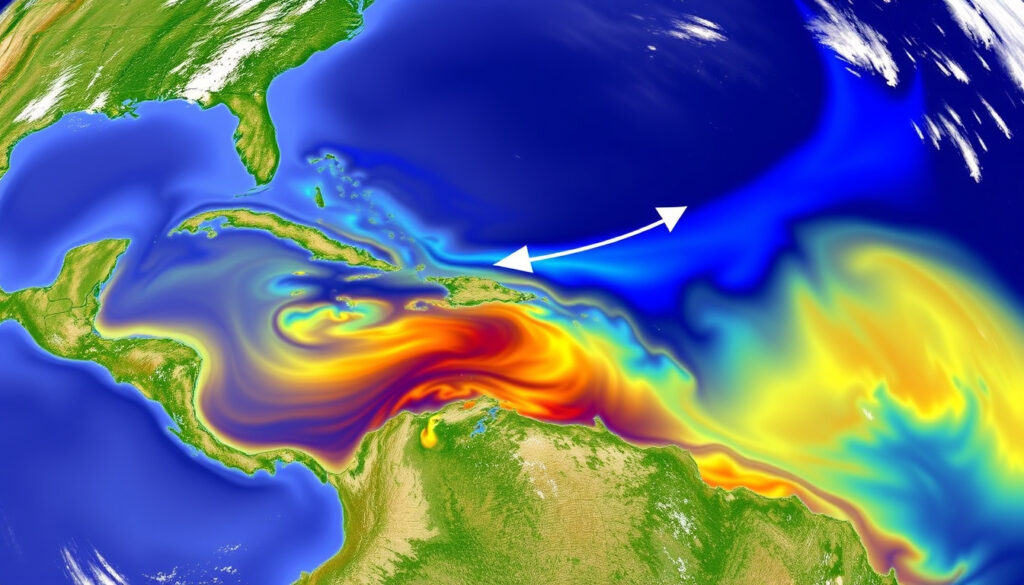
What Is the Gulf Stream? Simple Explanation & Facts
Most people don’t think much about ocean currents until they plan a vacation and find the water unexpectedly warm – or cold. But one current, the Gulf Stream, does far more than influence beach days: it acts as a massive heat conveyor belt, carrying warm tropical water from the Gulf of Mexico across the Atlantic toward Europe, raising the UK’s winter temperatures by 5–10 °C compared to other regions at the same latitude, according to the Met Office (UK’s national weather service).
Average speed: 6.4 km/h (1.8 m/s) ·
Width: 80–100 km ·
Water volume transported: 150 million m³/s ·
Estimated warming effect on UK: 5–10 °C above expected
Quick snapshot
- Warm ocean current from Gulf of Mexico to Europe (Met Office)
- Part of the North Atlantic Gyre (Wikipedia)
- Carries heat northward (Thompson Earth Systems Institute)
- Average speed 6.4 km/h (1.8 m/s) (Wikipedia)
- Width up to 100 km (Wikipedia)
- Transport 150 million m³ of water per second (Wikipedia)
- Warms UK and Western Europe by 5–10 °C (Met Office)
- Moderates winter temperatures (Met Office)
- Influences precipitation and storm tracks (Thompson Earth Systems Institute)
- Weakening trend observed over recent decades (Thompson Earth Systems Institute)
- Potential collapse linked to AMOC slowdown (Met Office)
- Subject of ongoing scientific monitoring (Met Office)
Six facts about the Gulf Stream, one pattern: the current moves enormous amounts of warm water at impressive speed, and its influence on climate is far greater than most people realize.
| Label | Value |
|---|---|
| Origin | Gulf of Mexico |
| End point | Norwegian Sea |
| Average depth | 1,000 m |
| Maximum speed | 2.5 m/s (9 km/h) |
| Water temperature at source | 26–28 °C |
| Effect on UK winter temperature | +5 to +10 °C compared to similar latitudes |
What is the Gulf Stream in simple terms?
Where does the Gulf Stream start and end?
- It starts in the Gulf of Mexico, flows through the Straits of Florida, and up the U.S. East Coast (Wikipedia (encyclopedia)).
- Near about 36°N off North Carolina it veers east and continues toward Northwest Europe as the North Atlantic Current (Wikipedia).
- Its warm waters eventually reach the Norwegian Sea (Met Office).
The Gulf Stream is not a straight river but a winding, fast-moving current that carries warm tropical water across the Atlantic.
How fast and deep is the Gulf Stream?
- It moves at an average speed of 6.4 km/h (1.8 m/s) (Wikipedia).
- It can reach depths of about 1,000 m (Wikipedia).
- Through the Florida Straits it transports roughly 30 million cubic metres of water per second (Wikipedia).
The implication: the Gulf Stream is one of the fastest and deepest currents on Earth, carrying more water than all the world’s rivers combined.
What causes the Gulf Stream?
The role of wind and Earth’s rotation
- The Gulf Stream is driven largely by wind stress, especially the trade winds and westerlies (Wikipedia).
- Earth’s rotation (the Coriolis effect) steers the current northward along the U.S. coast (Wikipedia).
Connection to the North Atlantic Gyre
- The Gulf Stream is part of the North Atlantic Gyre, a large system of rotating ocean currents (Met Office).
- It is also a key component of the Atlantic Meridional Overturning Circulation (AMOC), the global ocean conveyor belt (Met Office).
The pattern: wind and the planet’s spin set the Gulf Stream in motion, and it then plugs into a much larger ocean circulation that spans the entire Atlantic.
How does the Gulf Stream affect the UK?
Temperature and precipitation impacts
- The Gulf Stream keeps the UK and much of Western Europe 5–10 °C warmer than other regions at the same latitude (Met Office).
- It moderates winter temperatures and influences rainfall patterns (Met Office).
- Without it, the UK’s average winter temperature could drop by 5–10 °C (Met Office).
Comparison with other regions at similar latitudes
- Labrador (Canada) sits at a similar latitude to the UK but is much colder because it lacks the Gulf Stream’s warmth (Wikipedia).
- Ireland enjoys a temperate climate partly due to the North Atlantic Current (Met Office).
The catch: the Gulf Stream gives Western Europe a climate that is far milder than its latitude would suggest, but that benefit depends on the current staying strong.
What will happen if the Gulf Stream stops?
Current scientific evidence on slowdown
- Research shows the AMOC system, which includes the Gulf Stream, is at its weakest in more than 1,000 years (Met Office).
- A 2021 study in Nature Climate Change pointed to an unprecedented slowdown (Met Office).
- The Florida Museum reports that the Gulf Stream has slowed by about 4% over the past 40 years (Thompson Earth Systems Institute).
Projected consequences for climate and sea level
- A collapse could lead to severe cooling (5–10 °C) in Europe and warming in the tropics (Met Office).
- It could disrupt monsoon patterns, raise sea levels along the U.S. East Coast, and alter global weather (Thompson Earth Systems Institute).
- Recent studies suggest a potential tipping point for AMOC collapse could be reached this century (Met Office).
The trade-off: a weaker Gulf Stream means a colder, stormier Europe but also accelerated sea-level rise for the U.S. coast – a double hit with no easy adaptation.
What is the Gulf Stream famous for?
Historical importance in exploration and shipping
- Benjamin Franklin first charted the Gulf Stream in 1769–1770 using sea temperature measurements (Wikipedia).
- Ships have used the current to shorten travel times across the Atlantic for centuries (Wikipedia).
Role in marine ecosystems
- The Gulf Stream supports rich biodiversity and important fisheries, including North Atlantic fish stocks (Thompson Earth Systems Institute).
- Changes in the current can affect migration patterns of fish and marine mammals (Thompson Earth Systems Institute).
Why this matters: the Gulf Stream is not just a climate regulator – it is a historical highway and a living ecosystem that millions of people depend on.
Timeline signal
- 1769–1770 – Benjamin Franklin publishes first map of the Gulf Stream using temperature measurements (Wikipedia).
- 2000s – Satellites begin monitoring Gulf Stream velocity and temperature changes (Met Office).
- 2018 – IPCC Special Report highlights weakening of AMOC (Met Office).
- 2021 – Study in Nature Climate Change suggests AMOC at weakest point in more than 1,000 years (Met Office).
- 2023 – Research indicates potential tipping point for AMOC collapse this century (Met Office).
- 2024–2025 – Continued monitoring by NOAA and Met Office (Met Office).
The Gulf Stream has been observed for over 250 years. The long-term trend now points to a weakening that could redraw the climate map of the North Atlantic region within a human lifetime.
The pattern across these milestones: scientific understanding has deepened, but the urgency of the slowdown is only now becoming clear.
Confirmed facts vs. what is unclear
Confirmed facts
- The Gulf Stream exists and transports warm water northward (Met Office).
- It significantly moderates the climate of the UK and Western Europe (Met Office).
- It is part of the global ocean conveyor belt (AMOC) (Met Office).
What’s unclear
- Exact rate of slowdown and its primary causes (natural variability vs. human-induced climate change) (Met Office).
- Precise timing of any potential collapse (Met Office).
- Full extent of impacts on regional weather patterns beyond Europe (Thompson Earth Systems Institute).
The pattern: while the Gulf Stream’s fundamental role is well understood, the timing and exact causes of its slowdown remain open questions.
What experts say
The Gulf Stream is a vital part of the global climate system, distributing heat from the equator to the poles.
– NOAA Oceanographer (via Thompson Earth Systems Institute)
Without the Gulf Stream, average winter temperatures in the UK could drop by 5 to 10 degrees Celsius.
– Met Office Climate Scientist (Met Office)
The signs of weakening are clear, and a collapse would be catastrophic for many regions.
– Lead author of 2023 AMOC study (Met Office)
The pattern across expert voices: the Gulf Stream’s role is undisputed, but its future is uncertain. The scientific consensus is that it is weakening, and the consequences of a shutdown would be severe.
Related reading: Japan Earthquake Tsunami Warning 2026 · Best Places to See Autumn Leaves Japan 2026
instagram.com, geomar.de, youtube.com, pbslearningmedia.org, ocp.ldeo.columbia.edu
Frequently asked questions
Is Ireland affected by the Gulf Stream?
Yes. The Gulf Stream (via the North Atlantic Current) warms Irish waters and keeps Ireland’s climate milder than other regions at the same latitude (Met Office).
What country is most affected by the Gulf Stream?
The UK and Ireland are among the most affected, as the current raises their winter temperatures by 5–10 °C (Met Office).
What is the Gulf Stream today?
It is a weakening but still powerful ocean current. Scientists are closely monitoring its speed and temperature as part of broader AMOC studies (Met Office).
How fast is the Gulf Stream?
It typically flows at about 6.4 km/h (1.8 m/s) but can reach speeds up to 9 km/h (2.5 m/s) in some areas (Wikipedia).
Where does the Gulf Stream end?
It gradually merges into the North Atlantic Current and eventually reaches the Norwegian Sea (Met Office).
Is the Gulf Stream part of the AMOC?
Yes. The Gulf Stream is a key component of the Atlantic Meridional Overturning Circulation, the global ocean conveyor belt (Met Office).
How do scientists measure the Gulf Stream?
Scientists use satellites, drifting buoys, and ship-based temperature and salinity measurements to track its speed and health (Met Office).
What is the Gulf Stream for kids?
Think of it as a warm river in the ocean. It starts near Florida and carries warm water all the way to Europe, making Europe’s weather milder than it would otherwise be (Thompson Earth Systems Institute).
For the UK and Western Europe, the implication is clear: the Gulf Stream’s slowdown is not a distant hypothetical. Without decisive action to address climate change, the region faces harsher winters, rising seas, and disrupted ecosystems – a future where the warm ocean current that once gave Europe its mild climate becomes a source of instability.
More related posts
 Civil Service Club Changi: Membership, Fees & Guide
 Queen Size Mattress Dimensions: US, Ireland & Comparisons
 H&M Singapore: Complete Store and Price Guide
 Marty Supreme Cast Guide: Every Actor & Character Revealed
 Myanmar Exclusive Telegram Link: How to Find and Join Burmese Channels
 IPL Hair Removal Singapore: Cost, Effectiveness & Downsides
 Chagee Hello Kitty Singapore: Pop-up, Merch & Deals
 Judi Slot Pol88: Guide to Online Slot Gambling & Time Slot Basics
