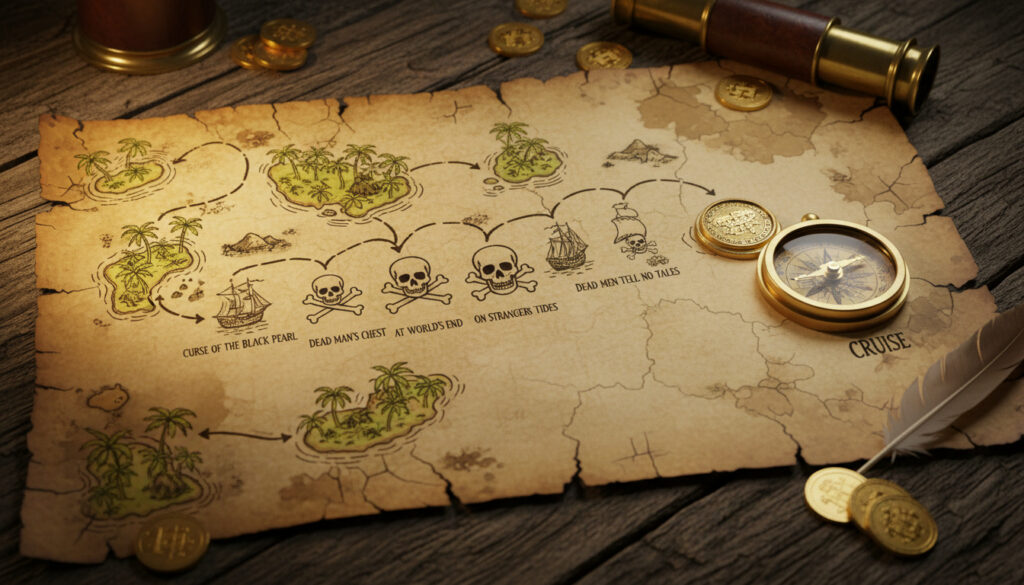
Pirates of the Caribbean – Watch Order for All Films
The Pirates of the Caribbean franchise represents one of Disney’s most successful theatrical gambles, converting a 1967 theme park attraction into a five-film saga that generated $4.52 billion worldwide. Since 2003, Johnny Depp’s portrayal of Captain Jack Sparrow has anchored the series through supernatural maritime adventures that blend historical piracy with fantasy mythology. Despite declining domestic returns for later installments, the franchise maintains significant cultural influence, though its sixth entry remains in developmental limbo.
Gore Verbinski launched the series with The Curse of the Black Pearl, establishing a visual template that subsequent directors Rob Marshall and Joachim Rønning & Espen Sandberg would modify. Jerry Bruckheimer’s production oversight ensured consistency across all five films, distributed by Walt Disney Studios Motion Pictures. The narrative spans roughly three decades of fictional 18th-century history, though the films follow a linear timeline that mirrors their release sequence.
Critical reception has varied significantly throughout the franchise’s lifecycle. While the original film earned a 79% Rotten Tomatoes score, later entries saw declining critical consensus, with On Stranger Tides dropping to 32%. Nevertheless, audience enthusiasm sustained the series through 2017, when Dead Men Tell No Tales concluded the current saga. Questions regarding a sixth installment and the potential return of Depp continue to dominate fan discourse.
How Many Pirates of the Caribbean Movies Are There?
The franchise comprises five primary theatrical releases produced between 2003 and 2017. No additional mainline sequels have reached production, though Disney has maintained active development on potential sixth and seventh entries since 2017. The series also includes numerous supplementary media, including video games, novelizations, and theme park integrations, but these five films constitute the core cinematic canon.
- Franchise Origin: Disney adapted the original Pirates of the Caribbean theme park attraction, which opened at Disneyland in 1967, into the 2003 film after decades of development attempts.
- Production Consistency: Jerry Bruckheimer produced all five films, ensuring visual and tonal continuity despite rotating directors.
- Financial Landmarks: Dead Man’s Chest (2006) and On Stranger Tides (2011) each crossed $1 billion globally, pioneering the billion-dollar blockbuster model for Disney.
- Critical Trajectory: Rotten Tomatoes scores declined from 79% (first film) to 32% (fourth film), though audience scores remained relatively stable.
- Cast Continuity: Johnny Depp, Geoffrey Rush, and Kevin McNally appear in all five films, forming the franchise’s central trio.
- Recent Status: Dead Men Tell No Tales (2017) remains the final theatrical release, earning $794 million worldwide against a $230-320 million budget.
| Film | Release Date | Director | Worldwide Gross | Runtime |
|---|---|---|---|---|
| The Curse of the Black Pearl | Gore Verbinski | $654 million | 143 minutes | |
| Dead Man’s Chest | Gore Verbinski | $1.066 billion | 151 minutes | |
| At World’s End | Gore Verbinski | $961 million | 169 minutes | |
| On Stranger Tides | Rob Marshall | $1.045 billion | Not specified | |
| Dead Men Tell No Tales | Joachim Rønning & Espen Sandberg | $794 million | Not specified | |
| Franchise Total | — | — | $4.52 billion | ~13 hours total |
Box Office Mojo tracks the series as the 15th highest-grossing franchise domestically and worldwide. The first film opened in 3,416 theaters, while subsequent releases expanded to over 4,100 locations.
Pirates of the Caribbean Movies in Order
Viewing the franchise requires understanding the distinction between production chronology and narrative timeline. The five films follow a predominantly linear story structure set during the early 18th century, primarily spanning the 1720s through 1750s, with each installment building directly upon its predecessor’s events.
Release Order and Narrative Continuity
The optimal viewing sequence follows theatrical release order, as this aligns closely with the internal chronology. The Curse of the Black Pearl introduces the core cast and curse mythology, while Dead Man’s Chest continues immediately afterward, introducing Davy Jones and the Kraken. At World’s End concludes the original trilogy’s narrative arc, resolving the conflict with the East India Trading Company.
Collider’s viewing guide confirms that subsequent films function as standalone adventures. On Stranger Tides shifts focus to the Fountain of Youth quest, while Dead Men Tell No Tales introduces Captain Salazar and explores Jack Sparrow’s earlier years through flashback sequences. Fan-maintained timelines indicate minimal temporal gaps between installments.
First-time viewers should watch in release order rather than attempting chronological rearrangement. The post-credits scenes in Dead Man’s Chest and At World’s End establish direct continuity that would lose impact if viewed out of sequence. Total runtime across all five films approximates 13 hours.
Chronological Story Elements
Within the fictional universe, events progress linearly from the first through fifth films. The sole nonlinear element appears in Dead Men Tell No Tales, which opens with a flashback depicting a young Jack Sparrow defeating Salazar. This sequence predates the events of The Curse of the Black Pearl by several decades, though the remainder of the fifth film occurs after At World’s End.
Is There a Pirates of the Caribbean 6?
Development of a sixth theatrical installment remains unconfirmed regarding production start dates, casting decisions, or narrative direction. Disney has commissioned multiple screenplay drafts since 2017, but no director has officially attached to the project, and studio documentation lacks release window specifications.
Development Status and Industry Reports
Multiple industry publications have reported on potential sixth and seventh film scripts, with Disney pursuing various narrative directions including a female-led spinoff and direct continuations. However, Collider’s franchise analysis notes that no official greenlight has occurred. Jerry Bruckheimer continues to advocate for the series’ continuation, though budget concerns following the fifth film’s underperformance relative to its $230-320 million production cost have complicated negotiations.
Casting Uncertainty and Johnny Depp
Johnny Depp’s potential involvement remains unresolved. The actor originated Jack Sparrow in 2003 and appeared in all five films, but his participation in future installments faces question marks due to previous legal disputes with Disney. No official statements from the studio or Depp’s representatives have confirmed either his return or exclusion.
Rumors regarding Margot Robbie’s involvement, specific plot details about the Fountain of Youth, or 2025 release dates remain unverified. Disney has not announced official production schedules, release dates, or confirmed casting for any sixth film.
Pirates of the Caribbean Cast and Characters
The franchise maintains specific casting continuity across its 14-year theatrical run, with three performers appearing in every installment. The ensemble blends established Hollywood stars with emerging talent, creating multi-generational appeal that sustained the series through cast rotations in later films.
The Central Performers
Johnny Depp anchors the series as Captain Jack Sparrow, the drunken, treacherous pirate captain whose moral ambiguity defines the franchise’s tone. Geoffrey Rush portrays Hector Barbossa, Sparrow’s rival-turned-ally who appears in all five films with shifting allegiances. Kevin McNally plays Joshamee Gibbs, Sparrow’s loyal first mate and the only character besides Jack to appear in every theatrical release. For those interested in other fantasy realms, check out this guide to Outlaws of Thunder Junction at Outlaws of Thunder Junction guide.
The original trilogy featured Orlando Bloom as Will Turner, a blacksmith-turned-pirate cursed to captain the Flying Dutchman, and Keira Knightley as Elizabeth Swann, the governor’s daughter who becomes a pirate lord. Both departed after At World’s End, returning only for brief cameos in Dead Men Tell No Tales. Bill Nighy portrayed the tentacle-faced Davy Jones in the second and third films, with CGI enhancements creating the character’s distinctive appearance.
Later Installment Additions
On Stranger Tides introduced Penélope Cruz as Angelica, Blackbeard’s daughter and Sparrow’s former love interest, alongside Ian McShane as the historical pirate Blackbeard. Dead Men Tell No Tales brought Javier Bardem as Captain Salazar, the undead pirate hunter, while Brenton Thwaites and Kaya Scodelario played the younger generation Henry Turner and Carina Smyth.
Beyond the core trio of Depp, Rush, and McNally, no other actors appear in all five films. Jonathan Pryce (Governor Swann) and Jack Davenport (Norrington) appeared only in the first three installments, while Stellan Skarsgård (Bootstrap Bill) and Chow Yun-Fat (Sao Feng) joined specifically for At World’s End.
Tamil Yogi Movie Download Risks highlights unauthorized distribution concerns that affect franchise revenues, though Disney maintains strict theatrical and streaming windows for the series.
When Did the Pirates of the Caribbean Franchise Release Its Major Installments?
- 1967: Disneyland opens the original Pirates of the Caribbean attraction in New Orleans Square, establishing the visual aesthetic and iconography later adapted for film. Source: Wikipedia
- July 9, 2003: The Curse of the Black Pearl debuts, earning $46 million opening weekend against a $140 million budget, eventually grossing $654 million worldwide. Source: Box Office Mojo
- July 7, 2006: Dead Man’s Chest opens to $135 million domestically, becoming the year’s highest-grossing film with $1.066 billion total. Source: IMDb
- May 25, 2007: At World’s End releases eleven months after its predecessor, earning $961 million despite mixed critical reception.
- May 20, 2011: On Stranger Tides marks Rob Marshall’s directorial debut for the series, achieving $1.045 billion globally on a $378.5 million budget.
- May 26, 2017: Dead Men Tell No Tales (internationally titled Salazar’s Revenge) concludes the current saga with $794 million worldwide, the lowest domestic performance since the original.
What Facts Remain Verified Versus Speculative Regarding Future Installments?
| Established Information | Uncertain or Unconfirmed |
|---|---|
| Five films released theatrically between 2003-2017 | Potential sixth film script status and greenlight timeline |
| Jerry Bruckheimer’s continued attachment as producer | Johnny Depp’s potential return as Jack Sparrow |
| Disney ownership and distribution rights confirmed | Specific plot details or villain concepts |
| Box office totals verified by industry tracking services | Budget allocations for future productions |
| Director rotations: Verbinski (3), Marshall (1), Rønning & Sandberg (1) | Directorial assignments for unproduced sequels |
How Did a Theme Park Attraction Become a Film Empire?
The franchise’s origin traces to Walt Disney’s 1967 Anaheim theme park installation, which itself drew inspiration from historical piracy and classical maritime mythology. For decades, the ride functioned as a standalone attraction until screenwriters Ted Elliott and Terry Rossio adapted its imagery—specifically the cursed treasure and skeletal pirates—into a feature-length narrative. The 2003 film retained the ride’s iconic line “Dead men tell no tales” as a central plot point in the fifth installment.
Disney’s risk in greenlighting a pirate film during an era of superhero emergence proved prescient. The series pioneered the modern cinematic universe model before Marvel’s consolidation, demonstrating that interconnected storytelling could sustain audience interest across multiple entries. Hans Zimmer’s musical score, particularly the main theme “He’s a Pirate,” became synonymous with swashbuckling cinema, influencing subsequent action-adventure compositions.
Critical assessments note that the franchise’s early success stemmed from balancing practical stunt work with emerging CGI technology, particularly in the skeletal transformation sequences of the first film. Later installments shifted toward digital effects, with Davy Jones representing breakthrough motion-capture technology in 2006.
What Do Primary Sources Indicate About Franchise Performance?
Industry documentation confirms the series’ commercial trajectory through verified financial reporting. Box Office Mojo records indicate that Dead Man’s Chest maintained the highest domestic gross at $423 million, while On Stranger Tides achieved the largest international performance despite weaker North American turnout.
Rotten Tomatoes editorial rankings place The Curse of the Black Pearl at 79% critical approval, followed by Dead Man’s Chest at 53%, At World’s End at 44%, On Stranger Tides at 32%, and Dead Men Tell No Tales at 30%. Audience scores remain consistently higher than critical consensus across all entries.
What Should New Viewers Understand Before Starting the Series?
The Pirates of the Caribbean franchise rewards viewing in release order, with approximately 13 hours of content delivering a complete narrative arc from The Curse of the Black Pearl through Dead Men Tell No Tales. New audiences should anticipate tonal shifts between the original trilogy’s interconnected storytelling and the standalone adventures of the fourth and fifth films. While Johnny Depp’s performance as Jack Sparrow remains the constant anchor, the supporting cast rotates significantly after the third installment. Those interested in cinematic franchises that blend practical effects with supernatural lore may find the series comparable to other Disney adventure properties, though viewers should avoid Bleu de Chanel Parfum Review distractions when researching viewing options.
Frequently Asked Questions
Why did Pirates of the Caribbean 5 underperform compared to earlier entries?
Dead Men Tell No Tales earned $172 million domestically, significantly lower than the original trilogy’s $300-423 million range. Critics cited repetitive plot structures, reduced originality in action sequences, and franchise fatigue following a six-year gap since On Stranger Tides. The $230-320 million production budget also limited profitability compared to the billion-grossing second and fourth films.
Which Pirates movie has the highest critical rating?
The Curse of the Black Pearl holds the franchise’s highest Rotten Tomatoes score at 79%, followed by Dead Man’s Chest at 53%. The 2003 original received praise for Johnny Depp’s unpredictable performance and practical special effects, setting a benchmark subsequent films failed to match critically.
How many hours does it take to watch all Pirates of the Caribbean movies?
The complete series runs approximately 13 hours across five films. Individual runtimes range from 143 minutes (The Curse of the Black Pearl) to 169 minutes (At World’s End), with the fourth and fifth films falling between these extremes.
Is Johnny Depp officially returning for Pirates 6?
No official confirmation exists regarding Depp’s involvement in a potential sixth film. While he originated Jack Sparrow and appeared in all five existing movies, his participation remains uncertain due to previous legal disputes with Disney. Neither the studio nor Depp’s representatives have announced decisions.
What was the most expensive Pirates of the Caribbean film to produce?
On Stranger Tides carries the highest reported budget at $378.5 million, making it one of the most expensive films ever produced. Filming locations in Hawaii, Puerto Rico, and the United Kingdom, combined with 3D photography requirements and extensive visual effects, drove costs above the original trilogy’s $140-300 million range.
Who directed the most films in the franchise?
Gore Verbinski directed three films: The Curse of the Black Pearl, Dead Man’s Chest, and At World’s End. Rob Marshall and the duo Joachim Rønning & Espen Sandberg each directed one installment, marking Verbinski as the definitive visual architect of the series.
Do the Pirates films follow the Disneyland ride’s storyline?
The films adapt visual elements and specific scenes from the 1967 attraction, including the cursed treasure, skeletal pirates, and the “Dead men tell no tales” phrase. However, the narrative of Jack Sparrow and the specific curse mechanics were created specifically for the 2003 film by screenwriters Ted Elliott and Terry Rossio.
More related posts
 Daily Pay Job Singapore – Top Platforms and Rates
 Apple Store Near Me: Ireland Locations, Hours & Appointments
 ICA Passport Photo Requirement: Size, Rules & Fixes
 How to Stop Shoes from Blistering: Prevention & Aftercare Guide
 Atlético Madrid vs Real Madrid: Record, Stats & 5-2 Win
 EVA Air Flight Attendant Death: Cause and Investigation
 Singapore COE Prices Rise: Latest Results and Renewal Impact
 Shruthi Narayanan Viral Video: What Happened and Her Response
