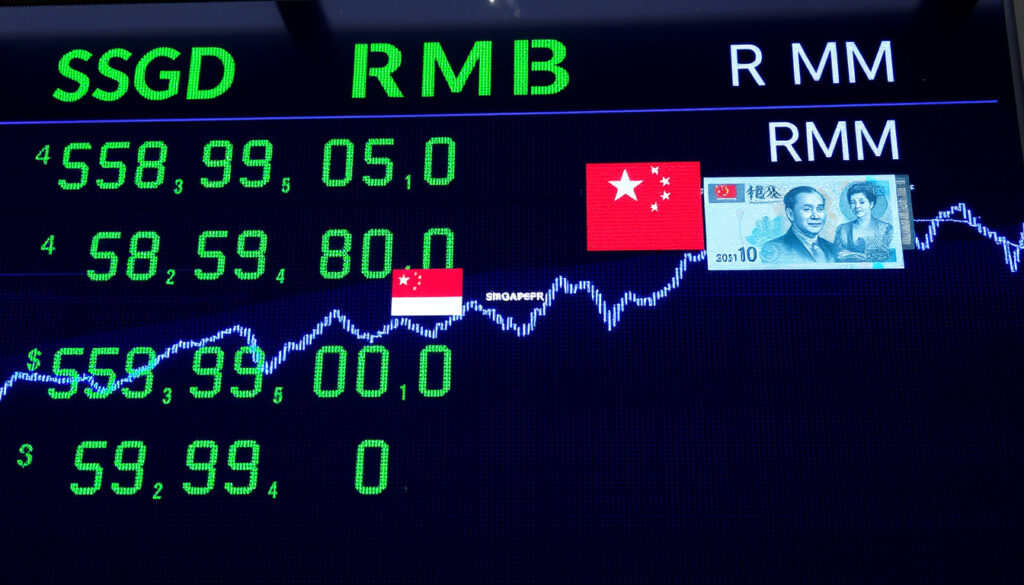
SGD to RMB Exchange Rate – Live Rates, History and Best Providers
The Singapore dollar to Chinese yuan exchange rate fluctuates throughout each trading day, reflecting broader movements in Asian currency markets. For anyone converting SGD to RMB—whether for business, travel, or remittance—understanding the current rate and its recent trajectory helps identify the optimal moment to execute a transfer. This guide compiles live mid-market rates from major providers, examines historical patterns, and outlines where Singapore-based users can access the most favorable terms.
The Chinese yuan carries the official designation CNY (Chinese Yuan Renminbi), though RMB remains widely used in everyday reference. Both terms describe the same currency, and exchange rate listings typically display the pair as SGD/CNY. Rates shown here represent mid-market values—the true wholesale rate between banks—though actual transfers may include provider fees discussed in detail below.
What is the SGD to RMB exchange rate today?
As of recent market data from multiple providers, the mid-market SGD to CNY rate hovers between 5.36 and 5.39 CNY per Singapore dollar. Providers publish slightly different figures reflecting their own fee structures and update frequencies. Revolut shows 5.596, while Wise lists 5.383 and OFX reports 5.345. These minor variations underscore why comparing providers before committing to a transfer matters.
The difference between the highest and lowest listed rate—around 0.25 CNY per SGD—translates to roughly 25 CNY extra on a 1,000 SGD transfer. Platform selection directly impacts how much foreign currency you ultimately receive.
5.36 – 5.39 CNY per SGD
Declined from 5.48 peak
5.37 – 5.60 CNY per SGD
Wise, Xe, OFX
Key Insights for Today’s Rate
- Mid-market rate across providers ranges approximately 5.345 to 5.596 CNY per SGD
- Rates have shown a slight downward trend since mid-2025 peaks above 5.59
- Volatility remains low, typically between 0.2% and 0.5% over short periods
- Provider fees—which may not appear in mid-market listings—can reduce the effective rate by 0.5% to 2%
- Bank transfers generally offer less competitive rates than dedicated transfer services
Quick Conversion Reference
| SGD Amount | CNY Equivalent (Mid-Market) |
|---|---|
| 10 SGD | Approximately 53.83 CNY |
| 100 SGD | Approximately 538.33 CNY |
| 1,000 SGD | Approximately 5,383.34 CNY |
| 10,000 SGD | Approximately 53,833.40 CNY |
| 1 CNY | Approximately 0.19 SGD |
What is the historical SGD to RMB exchange rate?
Examining the past twelve to eighteen months reveals a rate that trended upward through the first half of 2025 before pulling back in subsequent months. Data from OFX shows the pair reached its peak near 5.599 in June 2025, followed by a gradual decline that brought the average down to approximately 5.463 by November 2025. The overall average across the observed period settled around 5.511.
Short-Term Volatility Patterns
Recent market behavior demonstrates the pair’s relative stability compared to more volatile currency crosses. Over seven days, the rate moved within a 5.3715 to 5.4165 range—representing just 0.50% volatility. Thirty-day data shows a similar pattern, with the rate oscillating between 5.3715 and 5.4778, averaging 5.4373. The 90-day window narrows the range slightly to 5.3715 through 5.5164, with an average of 5.4463.
These figures reflect mid-market rates published by financial data aggregators. Actual amounts received when converting through a bank or transfer service may differ due to incorporated margins. Historical charts with more granular timeframes are available directly through providers like OFX and Xe.
Long-Term Trends and Monthly Averages
Looking at monthly aggregates, the pattern becomes clearer: the Singapore dollar strengthened against the yuan through mid-2025, peaked during the summer months, and has since given back some of those gains. The 2024 average sits slightly below the 2025 figure, indicating modest overall appreciation for SGD against CNY over the longer horizon. This historical context helps frame whether current rates represent a favorable entry point.
What is the SGD to RMB exchange rate forecast?
Published forecasts specifically addressing the SGD/CNY pair remain scarce in public financial reporting. Available analysis instead focuses on directional trends and the economic drivers that typically influence the cross. The recent depreciation from 2025 highs suggests continued softening, though the pace and magnitude of any further moves depend heavily on monetary policy decisions in both Singapore and China.
Factors That Could Influence Future Rates
The Monetary Authority of Singapore manages the local dollar against a trade-weighted basket of currencies, which insulates SGD from extreme volatility. Changes to Singapore’s monetary policy—such as adjustments to the Singapore Interbank Offered Rate (SIBOR) or its successor SOFR-linked benchmarks—can shift demand for the currency. Meanwhile, China’s central bank occasionally intervenes to stabilize the yuan, particularly when rapid depreciation might trigger capital outflows.
No reliable short-term forecast for the exact SGD/CNY rate exists in the public domain. Economic commentary and technical analysis may offer directional indicators, but currency markets respond to unexpected events—trade data releases, policy announcements, geopolitical developments—that no model can fully predict. Treat any rate projection as one of several possible outcomes rather than a certainty.
Monitoring Tools and Resources
Those tracking potential rate movements can use live data platforms to observe daily ranges and identify emerging patterns. Sites such as Investing.com provide real-time quotes alongside historical charts, while dedicated transfer platforms like MTFX display current positioning alongside recent changes. Reviewing these resources regularly helps spot when rates move into a historically favorable range.
Where to get the best SGD to RMB exchange rates?
Transfer services and fintech platforms consistently outperform traditional banks when converting SGD to CNY. Providers like Wise, Xe, OFX, Revolut, and Instarem publish rates close to the mid-market benchmark, retaining only small margin differences rather than the larger spreads banks typically apply. For Singapore-based users specifically, these platforms offer convenient digital onboarding and competitive transfer speeds.
Provider Comparison Overview
| Provider | Published Rate | Notes |
|---|---|---|
| Wise | 5.383 | Mid-market rate, transparent fees |
| Revolut | 5.596 | Live rate with continuous updates |
| OFX | 5.345 | As of March 18, 2026 |
| Xe | 5.391 | Mid-market, March 12, 2026 |
| Instarem | 5.364 | Current conversion rate |
| MTFX | 5.366 | Daily movement noted |
| Investing.com | 5.363 | Previous close: 5.356 |
Singapore-Specific Options
For those physically present in Singapore, local money changers remain an option for cash exchanges, though rates often diverge more significantly from mid-market benchmarks. Fintech solutions like YouTrip—a multi-currency card available in Singapore—use partnerships with payment networks to offer rates approaching the mid-market level, though specific SGD-to-CNY rates should be confirmed within the app before travel or transfers.
The Monetary Authority of Singapore oversees the regulatory environment for money changing services and fintech payment providers operating within the country. Users should verify that any chosen service holds appropriate licensing, particularly for larger transfers where regulatory oversight provides additional consumer protection.
Choosing the Right Transfer Method
Selecting an exchange service involves weighing several factors beyond the headline rate. Transfer speed matters for urgent payments—some services deliver within hours while others require several business days. Fee structures vary: some providers charge a flat transfer fee regardless of amount, while others charge a percentage. Minimum transfer requirements may apply on certain platforms, making them unsuitable for smaller conversions.
For businesses or individuals making recurring transfers, establishing an account with one or two preferred providers can simplify the process and sometimes unlock volume-based rate improvements. Checking the provider’s rate on the day of transfer—rather than relying on previously observed figures—ensures the most current terms apply to each transaction.
Timeline: SGD to CNY Exchange Rate Movements
The following timeline summarizes key observations from available historical data. Precise dates for rate peaks and troughs vary slightly between data providers; the figures below represent the most commonly reported patterns across major platforms.
- June 2025 — SGD/CNY reaches recent peak near 5.599, representing the strongest valuation of the Singapore dollar against the yuan in the observed period
- July – August 2025 — Rate begins gradual decline, averaging above 5.50 but off the June highs
- September – October 2025 — Continued softening brings monthly average closer to 5.48
- November 2025 — Average rate settles near 5.463, marking a notable pullback from summer peaks
- March 2026 — Current rates stabilize in the 5.36 to 5.39 range, representing continued modest decline from 2025 highs
Live charting tools from Wise and OFX offer more detailed historical views spanning multiple years, which can inform longer-term analysis for those planning substantial transfers or hedging strategies.
What is certain and what remains unclear?
Established Information
- Current mid-market rate falls between 5.36 and 5.39 CNY per SGD
- Rates peaked near 5.599 in mid-2025 and have since trended downward
- Volatility remains low at approximately 0.2% to 0.5%
- Multiple providers publish live rates with minor variations
- Dedicated transfer services consistently offer better rates than banks
Uncertain or Unverified Information
- Short-term rate predictions do not exist in verifiable public sources
- YouTrip’s exact SGD/CNY spread has not been independently confirmed
- Specific money changer rates in Singapore require on-site verification
- Future monetary policy decisions remain unknowable
- The impact of potential geopolitical events on the rate cannot be forecast
Understanding the SGD and CNY Relationship
Singapore’s economy relies heavily on trade, and the Monetary Authority of Singapore manages the local dollar through a managed float against a basket of currencies. This approach stabilizes SGD while allowing gradual appreciation against weaker counterparts. China, meanwhile, maintains more direct control over the yuan’s value, occasionally adjusting the daily reference rate to manage economic conditions.
The relationship between these two currencies reflects broader economic dynamics: Singapore’s role as a financial hub and trading gateway, China’s position as a major trading partner for Southeast Asia, and the differing monetary policy frameworks governing each. For individuals and businesses transacting between the two economies, these structural factors contribute to the exchange rate environment.
Those interested in the broader context of Singapore’s financial infrastructure may find value in understanding how the local retail landscape accommodates currency conversion needs, particularly for e-commerce transactions involving Chinese merchants.
Sources and Data References
Exchange rate data referenced in this article comes from providers that publish live and historical currency information. The mid-market rates represent wholesale benchmarks used by financial institutions; actual transfer rates incorporate provider margins that vary by service.
“Wise uses the real exchange rate, the same rate you see on Google and Reuters.” — Wise website, describing their mid-market rate approach
“Xe is one of the most popular currency conversion websites, providing mid-market rates updated by the minute.” — Xe’s published methodology statement
Data aggregation platforms like Revolut, Instarem, and MTFX similarly publish real-time quotes that inform the rate comparisons shown above.
Summary: Key Takeaways on SGD to RMB Exchange Rates
The SGD to CNY exchange rate currently trades around 5.36 to 5.39, having retreated from mid-2025 highs above 5.59. The pair exhibits low volatility, making it relatively predictable in short-term windows while still being subject to economic and policy-driven shifts over longer periods. For conversions from Singapore dollars to Chinese yuan, dedicated transfer services like Wise, Xe, and OFX consistently deliver rates closer to the mid-market benchmark than traditional banks. Checking live rates on the day of transfer, comparing across multiple platforms, and understanding how fees factor into the effective rate all contribute to better outcomes for anyone needing to convert between these currencies.
Frequently Asked Questions
What is 100 SGD to RMB?
At current mid-market rates around 5.38 CNY per SGD, 100 Singapore dollars converts to approximately 538 CNY. The exact amount varies slightly depending on which provider’s rate applies at the time of transfer.
What is the SGD to HKD exchange rate?
SGD to HKD (Hong Kong dollar) represents a separate currency pair not covered in detail here. Both SGD and HKD are regional financial hub currencies with their own exchange mechanisms. Multi-currency converters on platforms like Wise, Revolut, or Xe can provide current SGD/HKD rates.
How does YouTrip work for SGD to CNY conversions?
YouTrip is a Singapore-issued multi-currency card that loads and stores SGD, then converts to other currencies—including CNY—at rates determined by their payment network partnerships. Specific rates should be verified within the app before use, as they may not match mid-market benchmarks exactly.
Is the exchange rate the same at banks as at transfer services?
No. Banks typically apply wider spreads above the mid-market rate, resulting in less favorable effective rates for customers. Dedicated transfer services like Wise, OFX, and Xe generally offer rates closer to the true market rate, though fees may still apply depending on transfer amount and speed.
How often do SGD/CNY rates change?
Exchange rates update continuously throughout trading hours as market conditions evolve. The rate may shift multiple times within a single day, though the magnitude of these changes is typically small given the pair’s low volatility. Using a live converter tool provides the most current figure for any given moment.
Can I lock in an exchange rate for a future transfer?
Some providers offer forward contracts or rate guarantee options that allow users to secure a specific rate for a future date, typically with a small fee. These products suit those with a known future payment amount who want to eliminate exchange rate uncertainty. Availability and terms vary by provider.
What affects the SGD to CNY exchange rate?
Both currencies respond to monetary policy decisions, economic data releases, trade flows, and investor sentiment. Singapore’s managed float against a currency basket and China’s occasionally interventionist approach to the yuan create different dynamics for each. Broader factors including commodity prices, regional growth rates, and global risk appetite also influence the pair.
More related posts
 Atlético Madrid vs Real Madrid: Record, Stats & 5-2 Win
 Happy Chinese New Year 2026 Wishes: Messages & Quotes
 DBS Online Account Opening: Step-by-Step Guide
 Jacky Cheung Concert 2025: Singapore & KL Dates, Tickets
 Exchange Rate Singapore to India: SGD to INR Guide
 Tallest Building in the World – Burj Khalifa Facts and Rankings
 Cast of It Chapter 1: Full Actors List & Characters
 Tan See Leng GRC: Chua Chu Kang Role, Career & Background
