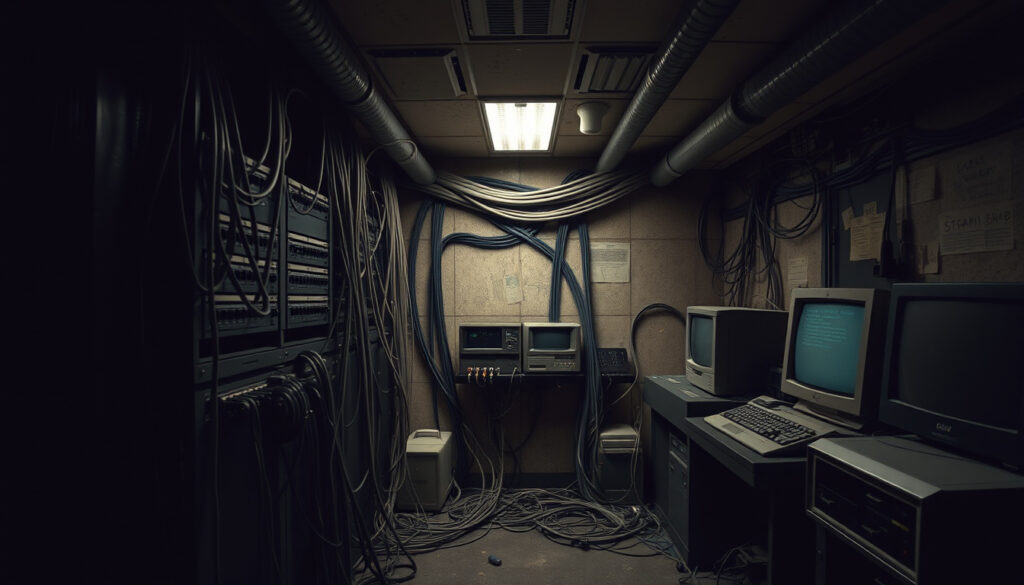
What I a Token Ring? How It Work & Why It’ Ob olete
If you’ve ever wondered why early computer networks sometimes felt like a carefully choreographed dance rather than a free-for-all, the answer might be Token Ring. This LAN technology, introduced by IBM in 1984, used a token-passing scheme to prevent data collisions.
Introduced by: IBM in 1984 ·
Maximum speed: 16 Mbps ·
Topology: Ring ·
Cable type: Shielded twisted pair ·
IEEE standard: 802.5 ·
Current status: Obsolete
Quick snapshot
- Token Ring was introduced by IBM in 1984 (Wikipedia)
- Maximum speed was 16 Mbps (Wikipedia)
- IEEE 802.5 standard (Wikipedia (tech reference))
- Exact historical pricing of Token Ring hardware
- Market share percentages at the technology’s peak
- Specific number of active Token Ring networks today
- IBM introduces Token Ring in 1984 (UC Davis research)
- Token Ring is now obsolete and replaced by Ethernet (Scribd technical analysis)
Key specifications of Token Ring at a glance:
| Introduced by | IBM |
| Year | 1984 |
| Maximum speed | 16 Mbps |
| Topology | Ring |
| Cable type | Shielded twisted pair |
| Standard | IEEE 802.5 |
| Status | Obsolete |
What is token ring and how does it work?
What is the purpose of a token ring?
- According to Wikipedia, Token Ring is a physical and data-link layer LAN technology built around a token-passing access method to prevent collisions.
- It uses a small token frame that circulates around a logical ring; only the station holding the token can transmit (ITU Online IT Training).
This deterministic approach was attractive in enterprise environments because it eliminated the collision problems that plagued early shared Ethernet (ITU Online IT Training).
The pattern: Token Ring’s turn-taking enforced order but introduced latency, which was a trade-off accepted in deterministic environments.
What is an example of a token ring?
The most widely known implementation is IBM’s Token Ring network, first released in 1984. It used a Multi-Station Access Unit (MSAU) that physically wired stations in a star but formed a logical ring. Many large corporations and financial institutions adopted it during the 1980s and 1990s (ITU Online IT Training).
What topology does token ring use?
Token Ring uses a logical ring topology, though the physical wiring often resembles a star. Data travels sequentially from one station to the next, passing through each node until it reaches its destination (Wikipedia).
What this means: the ring topology enforced turn‑taking, which guaranteed that every station got a fair chance to send data. But that fairness came at the cost of added delay while waiting for the token.
What are the advantages and disadvantages of token ring?
What are the main advantages of token ring?
- Deterministic access – transmission opportunities are scheduled, not random (ITU Online IT Training).
- Collision‑free – only the token holder transmits at any moment (ITU Online IT Training).
- Fairness – each station gets an equal chance to send data (ITU Online IT Training).
- Access priority – some nodes can be given priority over the token (Wikipedia).
What are the main disadvantages of token rings?
- Higher hardware and cabling costs (ITU Online IT Training).
- Maximum speed of only 16 Mbps, far slower than later Ethernet.
- Complex setup and maintenance (ITU Online IT Training).
- Single point of failure in the ring (though IBM’s MSAU mitigated this).
Upsides
- Deterministic, no collisions, fair access
Downsides
- Expensive, limited speed, complex, single point of failure
The trade‑off: Token Ring’s guaranteed latency and collision‑free operation were ideal for mission‑critical applications, but the cost and speed ceiling made it hard to justify as Ethernet prices dropped.
How does token ring compare to Ethernet?
Token ring vs Ethernet: key differences
Two LAN philosophies, one clear winner. The table below contrasts the core attributes:
| Aspect | Token Ring | Ethernet (pre‑switched) |
|---|---|---|
| Access method | Token passing (deterministic) | CSMA/CD (contention‑based) |
| Collision handling | Collision‑free by design | Collisions occur; recovered via backoff |
| Topology | Logical ring | Bus (later star) |
| Cost | Expensive hardware & cabling | Inexpensive, mass‑produced |
| Max speed | 4–16 Mbps | 10–100 Mbps by the 1990s |
| Standard | IEEE 802.5 | IEEE 802.3 |
Why did Ethernet win?
According to UC Davis research, the Ethernet community improved cost and usability more aggressively than IBM’s Token Ring ecosystem. Switched Ethernet and full‑duplex links eliminated most collision problems (Wikipedia). By the time Gigabit Ethernet arrived, Token Ring was too expensive and too slow to compete.
The pattern: Ethernet’s open, commodity‑driven ecosystem scaled faster and cheaper than IBM’s proprietary, high‑reliability approach.
Is token ring obsolete?
Is token ring still used today?
No. According to Scribd technical analysis, Token Ring is now largely obsolete in mainstream LAN deployments. The last formal standard was Gigabit Token Ring (IEEE 802.5z), published in 2001 (Wikipedia).
What replaced token ring?
- Ethernet, first at 10 Mbps, then 100 Mbps, and now 1 Gbps+
- Switched Ethernet eliminated collisions, removing Token Ring’s key advantage
Timeline of decline:
- 1984 – IBM introduces Token Ring (Wikipedia)
- 1985 – IEEE 802.5 standard published (Wikipedia)
- Late 1980s – Token Ring gains adoption in enterprise LANs (ITU Online IT Training)
- 1990s – Ethernet dominates due to lower cost and higher speeds (Scribd technical analysis)
- 2000s – Token Ring declared obsolete (Scribd technical analysis)
- 2009 – IEEE withdraws 802.5 standard (Wikipedia)
Why this matters: for organizations that invested in Token Ring infrastructure, the switch to Ethernet required a complete hardware overhaul. The lack of backward compatibility accelerated the technology’s disappearance.
How much does a token ring cost?
Cost of token ring hardware
Token Ring network interface cards (NICs) were significantly more expensive than Ethernet NICs. According to ITU Online IT Training, Token Ring hardware was generally more expensive and required specialized cabling (shielded twisted pair), further raising deployment costs. Exact historical pricing is unclear, but Ethernet’s economies of scale made its hardware a fraction of the price.
Cost vs Ethernet
By the mid‑1990s, a 10 Mbps Ethernet NIC could be had for under $50, while Token Ring cards often cost several hundred dollars. For network managers building large LANs, the cost difference was decisive.
The catch: Token Ring’s premium was justified for environments that absolutely needed deterministic latency, but for most general‑purpose LANs, Ethernet’s lower cost won out.
Confirmed facts
- Token Ring introduced by IBM in 1984 (Wikipedia)
- Maximum speed 16 Mbps (Wikipedia)
- IEEE 802.5 standard (Wikipedia)
- Token Ring is obsolete (Scribd technical analysis)
What’s unclear
- Exact historical pricing
- Market share percentages at peak
The lesson: For IT managers who once bet on Token Ring, predictability came at a cost that the market eventually refused to pay.
Token Ring is a physical and data link layer technology that uses a token‑passing scheme to prevent collisions. (— Wikipedia)
Token Ring’s controlled turn‑taking made it collision‑free in the sense that only the token holder transmits at a given moment. (— ITU Online IT Training)
For IT managers who once bet on Token Ring, the lesson is clear: a technology that prioritizes predictability over cost and scalability will eventually be outmatched. Ethernet’s ability to evolve—from shared media to switched, from 10 Mbps to 10 Gbps—showed that adaptability beats rigidity.
För den som vill förstå mekanismen bakom och varför tekniken försvann rekommenderas Hur Token Ring fungerar och varför det blev omodernt som förklarar IBM:s token-passing-metod och Ethernet-segern.
Frequently asked questions
What is token ring?
Token ring is a local area network (LAN) technology that uses a token-passing access method to control data transmission on a logical ring topology.
How does token ring work?
A small token frame circulates around the ring. A station can only transmit data when it captures the token, ensuring collision-free communication.
What is the difference between token ring and Ethernet?
Token ring uses deterministic token passing, while Ethernet uses contention-based CSMA/CD (originally). Token ring is collision-free but slower and more expensive.
Why is token ring not used anymore?
Ethernet became cheaper, faster, and more scalable. Switched Ethernet eliminated collisions, removing token ring’s main advantage. The IEEE withdrew the 802.5 standard in 2009.
What are the advantages of token ring?
Deterministic access, no collisions, fair access for all stations, and support for traffic priority.
What speed does token ring support?
Token ring operated at 4 Mbps and later 16 Mbps. The Gigabit Token Ring standard (802.5z) existed but never saw widespread deployment.
Also read: Error Definition: Types, 404 Fixes, Synonyms & More
More related posts
 Schneider Electric Share Price: Buy, Sell, Hold? (2026)
 MRT Blue Line Map: Stops, PDF Download & Route Guide
 CPF Minimum Sum 2026: BRS $110,200 FRS $220,400 Explained
 Ahn Jae-hyun – Career Dramas and Divorce Facts
 Happy Meal Toy Singapore – Super Mario Schedule Guide
 LTA Car Plate Bidding: How to Bid for a VRN in Singapore
 Light Shop Near Me – Best Lighting Stores in Atlanta
 201D Tampines Street 21 Guide: Shops, Food & Nearby Hawkers
