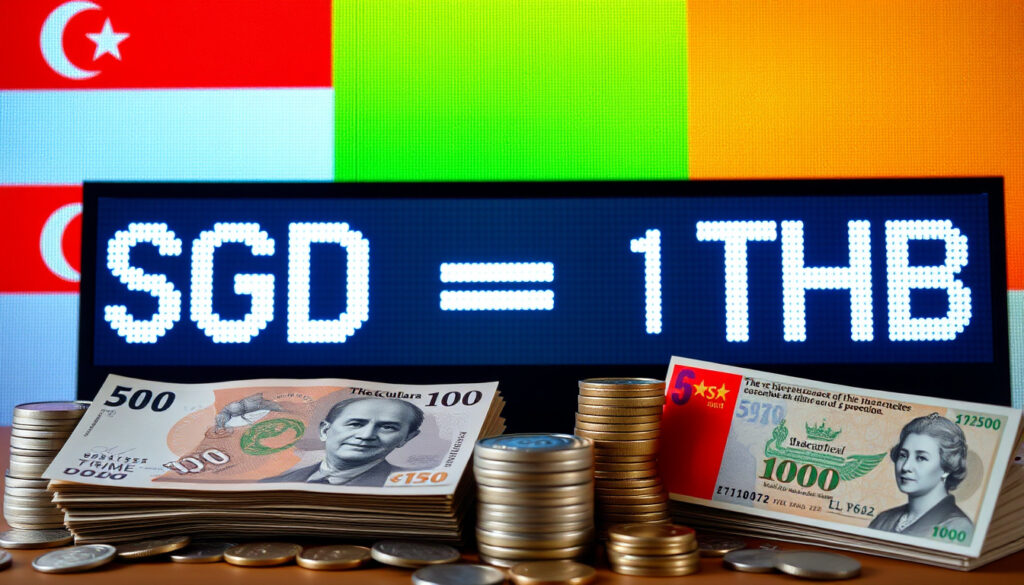
SGD to THB: Singapore Dollar to Thai Baht Exchange Rate
If you’re exchanging Singapore dollars for Thai baht, the difference between providers can be substantial. On a S$1,000 transfer, choosing the best available rate over the worst can mean receiving an extra ฿1,274 in your pocket. This guide walks through current SGD to THB rates, compares the top providers against bank counters, and gives you a step-by-step process for getting the most baht for your dollar.
Current Rate: 1 SGD = 25.34 THB · 100 SGD Value: 2,534 THB · Top Provider: Wise · Bank Reference: Bangkok Bank · Live Converter: th.coinmill.com
Quick snapshot
- The mid-market rate sits near 25.34–25.51 THB per SGD (Xe Currency Converter)
- Panda Remit offers the best rate at 1 SGD = 25.5304 THB (RemitFinder comparison)
- The SGD/THB rate has declined 4.30% over the past six months (Exchange-Rates.org historical data)
- Exact tomorrow rate — exchange rates fluctuate based on market conditions
- Real-time rates as of April 26, 2026 are limited; most sources show late 2025 or early 2026 data
- Highest rate: 25.643 THB on March 26, 2026 (Exchange-Rates.org)
- Lowest rate: 24.168 THB on December 12, 2025 (Exchange-Rates.org)
- Compare live rates from Wise, Revolut, OFX, and other providers before transferring
- Banks remain approximately 1.19x more expensive than dedicated money transfer services
These key figures come from multiple authoritative sources tracking SGD to THB exchange rates across the market.
| Field | Value |
|---|---|
| ISO Codes | SGD / THB |
| 1 SGD Equals | 25.34 THB |
| Top Site Rate | Wise.com |
| Bank Source | Bangkok Bank |
How many Thai baht is 100 Singapore dollars?
At the current mid-market rate of approximately 25.34 THB per SGD, 100 Singapore dollars converts to roughly 2,534 Thai baht. However, the rate you actually receive depends heavily on which provider you use. According to RemitFinder, Panda Remit offers the best available rate at 25.5304 THB per SGD, which would give you 2,553 THB for 100 SGD — about 19 baht more than the mid-market baseline.
Live rate from Wise
Wise provides the mid-market exchange rate of 1 SGD = 24.9437 THB with a transparent fee of 6.83 SGD for 1,000 SGD transfers. For 100 SGD, this works out to approximately 2,494 THB before transfer fees are considered. The platform is known for its fee transparency — you see exactly what rate you’re getting before committing.
“Wise consistently offers rates closest to the mid-market rate, though their fees vary by transfer amount and destination.”
— RemitFinder rate analysis, April 2026
Bank rates comparison
Traditional banks charge significantly more. RemitFinder found that banks are approximately 1.19x more expensive than money transfer companies for Singapore to Thailand transfers. The average FX markup for money transfer providers is 2.03%, while banks add roughly 0.87 percentage points more on top of that. If you exchange S$100 at a typical bank counter, you might receive only 2,460 THB — roughly ฿70–90 less than the best digital providers.
“Banks consistently apply higher margins than dedicated remittance services, making them the least favorable option for currency exchange.”
— RemitFinder provider comparison
The implication: for small transfers like S$100, the provider gap may look modest in absolute terms, but it compounds significantly at larger volumes.
For a S$100 conversion, the difference between the best and worst providers amounts to roughly ฿30–70. It may seem small, but the gap widens substantially with larger transfers.
How many Thai baht is 50 Singapore dollars?
At a mid-market rate of 25.34 THB per SGD, 50 Singapore dollars equals approximately 1,267 THB. The exact figure again depends on your provider. Wise offers 24.9437 THB per SGD, yielding around 1,247 THB, while Panda Remit’s rate of 25.5304 THB would give you approximately 1,277 THB.
Coin and note values
For those exchanging physical currency, Singapore’s 50-cent coin is worth roughly 12.67 THB at current rates. Note denominations (S$10, S$20, S$50, S$100) convert proportionally. Most exchange counters accept Singapore polymer notes without issue, though coin exchanges may face more limited acceptance or slightly worse rates.
Small amount exchanges
If you’re exchanging S$50 or less at a physical counter, be aware that many exchange bureaus add a minimum fee that effectively reduces the rate. Some counters charge a flat fee of 50–100 THB per transaction, which can eat significantly into small exchanges. Digital transfers make more sense for amounts under S$200 as the fee percentage becomes prohibitive at physical counters.
The pattern: flat fees hit small transfers hardest, eroding the effective exchange rate by a larger percentage than for larger amounts.
For a S$50 exchange with a ฿50 flat counter fee, you’re effectively losing about 4% of your value upfront. Digital providers typically have lower minimum thresholds or no flat fees for small transfers.
How much Thai baht for 1000 Singapore dollars?
This is where provider choice becomes critically important. At the mid-market rate of 25.34 THB per SGD, S$1,000 would convert to approximately 25,340 THB. But RemitFinder’s analysis of 16 money transfer providers shows a rate range from 24.2560 to 25.5304 THB per SGD. That span means the difference between best and worst providers is ฿1,274 for a single S$1,000 transfer.
Large transfer options
For transfers of S$1,000 or more, dedicated remittance services typically offer better rates than banks. Panda Remit leads at 25.5304 THB per SGD, followed by Revolut at 25.4928 THB and OFX at 25.174568 THB. Each provider has different transfer limits, processing times, and fee structures that affect the total value received.
Panda Remit rates
Panda Remit currently offers the best SGD to THB rate among 16 compared providers. At 25.5304 THB per SGD, a S$1,000 transfer would yield approximately 25,530 THB before fees. The platform typically processes transfers within 1–3 business days, though exact delivery times depend on the chosen method.
What this means: choosing Panda Remit over an average provider on a S$1,000 transfer delivers an extra ฿1,274 in the recipient’s account before any fees are considered.
How much is 5000 Singapore dollars in Thai baht?
At Panda Remit’s leading rate of 25.5304 THB per SGD, a S$5,000 transfer converts to approximately 127,652 THB. Using the mid-market rate of 25.34, the same S$5,000 would yield 126,700 THB. The gap between best and worst providers across the market spans from approximately ฿121,280 to ฿127,652 — a difference of over ฿6,000 on a single large transfer.
Bulk exchange
For larger amounts like S$5,000, some providers offer tiered pricing or better rates for first-time users. CurrencyTransfer connects users with FCA-regulated specialists for SGD to THB conversions, claiming potential savings up to 85% versus traditional banks. However, these services typically require larger minimum transfers and may have specific eligibility criteria.
Wise for high volumes
Wise charges a transparent fee that scales with transfer amount. For 1,000 SGD, the fee is 6.83 SGD. Extrapolating, a S$5,000 transfer would carry a proportional fee. The platform’s mid-market rate of 24.9437 THB per SGD means S$5,000 converts to approximately 124,719 THB before fees. After the proportional fee is applied, the net amount received in THB is calculated against this rate.
The catch: some providers advertise favorable headline rates but add percentage-based fees that erode gains. Always confirm the total cost — both the rate and any transfer fees — before committing.
For S$5,000 transfers, some providers advertise favorable headline rates but add percentage-based fees that erode gains. Always confirm the total cost — both the rate and any transfer fees — before committing.
Where to exchange Singapore dollars for Thai baht?
Choosing where to exchange matters almost as much as timing. RemitFinder compared 16 money transfer providers and found that banks charge approximately 1.19x more than dedicated remittance services for Singapore to Thailand transfers. For those exchanging in Thailand, bank branches like Bangkok Bank offer official rates, though typically at less competitive margins than digital alternatives.
Banks like Bangkok Bank
Bangkok Bank publishes official foreign exchange rates on its website and at branch counters. Physical exchange at bank branches is convenient but comes at a cost — the rate will be worse than mid-market by roughly the bank’s margin. Bangkok Bank’s rates page is accessible online, allowing you to check current pricing before visiting a branch.
Airport and city counters
Airport exchange counters consistently offer the worst rates among physical locations. If you must exchange at an airport, limit it to a small amount for immediate needs like transport. City counters in tourist areas often provide slightly better rates than airports but still fall short of what digital providers offer. The Bank of Thailand provides official daily foreign exchange rates as a reference point starting from April 1, 2025.
The pattern is clear: physical counters — whether at airports, banks, or currency exchanges — add margins that digital providers avoid. For anything beyond small emergency exchanges, comparing rates from Wise, Revolut, Panda Remit, and similar platforms before you travel will almost always yield more baht per dollar.
Below is a comparison of exchange rates and fees across major providers for SGD to THB transfers.
| Provider | Rate (SGD to THB) | Transfer Fee | Key Feature |
|---|---|---|---|
| Panda Remit | 25.5304 | Varies | Best overall rate among 16 providers |
| Revolut | 25.4928 | Low/minimal | Fintech platform, competitive rates |
| OFX | 25.174568 | No flat fee | Established exchange service |
| Wise | 24.9437 | Transparent fee | Mid-market rate with clear pricing |
| Western Union | Varies daily | Per transaction | Global reach, daily rate updates |
| Traditional Banks | Below mid-market | Higher margins | Branches available, but 1.19x more expensive |
How to convert SGD to THB: Step by step
Whether you’re transferring money to Thailand or converting cash before travel, the process follows a similar path. Here’s how to maximize your baht:
- Check the mid-market rate first. Use a reference site like XE or the Bank of Thailand to see the interbank rate. This is your baseline for comparison.
- Compare at least three providers. Check Panda Remit, Revolut, Wise, and OFX directly. RemitFinder’s comparison shows rates from THB 24.2560 to 25.5304 per SGD across 16 providers.
- Account for fees. Some providers advertise strong rates but add transfer fees. Calculate the total baht you would receive, not just the headline rate.
- Consider transfer speed. If you’re sending money to a Thai bank account, standard transfers take 1–3 business days. Same-day options exist but typically cost more.
- Confirm recipient details. Thai bank transfers require a recipient account number and bank code. Errors can cause delays and additional fees.
Promotional rates with negative markups (as low as -2.51% according to RemitFinder) are temporary. Don’t rely on today’s best promo rate for timing decisions — the market moves, and what looks like a gain could vanish by transfer day.
Upsides
- Digital providers consistently beat bank rates by 15–20% for SGD-THB transfers
- Maximum savings on S$1,000 transfers reach ฿1,274 by choosing Panda Remit over worst provider
- Wise, Revolut, and OFX offer transparent fee structures — no hidden charges
- Bank of Thailand publishes official daily rates as a reliable reference point
Downsides
- Physical counters at airports and banks still offer worse rates than digital alternatives
- FX markup varies dramatically: from -2.51% promotional rates to 11.90% at worst providers
- The SGD has declined 4.30% against THB over six months — timing matters
- Minimum transfer amounts at some providers may exceed what casual travelers need
Related reading: SGD to RMB Exchange Rate
ofx.com, xe.com, wise.com, ofx.com, currencytransfer.com, xtransfer.com, revolut.com, exchangerates.org.uk, revolut.com
While Panda Remit offers the best at 25.53 THB per SGD, the 100 SGD to Thai Baht guide delivers live rates and practical exchange tips for travelers converting around 100 SGD.
Frequently asked questions
What affects SGD to THB rates?
Exchange rates between SGD and THB fluctuate based on monetary policy from the Monetary Authority of Singapore and the Bank of Thailand, trade balances, inflation differentials, and broader forex market sentiment. Over the past 180 days, the rate has ranged from 24.168 THB (December 12, 2025) to 25.643 THB (March 26, 2026).
Is now a good time to exchange SGD?
The SGD/THB rate has declined 4.30% over the past six months, meaning the Singapore Dollar buys fewer baht than it did. If you need Thai baht for an upcoming trip or transfer, waiting for a rate above the 180-day average of 24.804 THB would be prudent, though predicting exact peaks is impossible.
How to transfer SGD to THB online?
Create an account with a provider like Wise, Panda Remit, or Revolut. Verify your identity, enter the recipient’s Thai bank details, specify the amount in SGD, review the rate and fees, then initiate the transfer. Most digital providers process SGD to THB transfers within 1–3 business days.
What fees do banks charge for SGD exchange?
Banks typically add a margin of 0.87 percentage points more than money transfer providers, making them approximately 1.19x more expensive overall. Some banks also charge flat transaction fees or percentage-based charges. Always ask for the all-in rate before exchanging at a bank counter.
Can I exchange SGD coins in Thailand?
Singapore coins are rarely accepted at Thai exchange counters. Most counters accept Singapore dollar banknotes (polymer notes) but not coins. If you have SGD coins, consider exchanging them at a Singapore bank before travel, or deposit them into a Wise or Revolut account and transfer the equivalent digitally.
What is the reverse rate THB to SGD?
Taking the inverse of the current 25.34 THB per SGD rate, 1 THB equals approximately 0.0395 SGD. To get 1,000 THB in Singapore dollars, you would divide by the rate: roughly 39.46 SGD. The exact reverse rate depends on the provider and their specific spread.
How often do exchange rates update?
Most digital providers update SGD to THB rates in real time or multiple times daily during market hours. Bank rates may update less frequently — sometimes once daily. For precise conversion, check your specific provider’s rate at the moment of transaction rather than relying on rates seen hours earlier.
For anyone regularly moving money between Singapore and Thailand, the choice of provider is the single biggest controllable variable. Banks and airport counters have their place for last-minute emergencies, but the data is clear: a S$5,000 transfer through a dedicated provider like Panda Remit instead of a typical bank branch can mean an extra ฿6,000 in the recipient’s account. The Singapore Dollar may be weakening against the baht — don’t let provider margins compound the loss.
More related posts
 Badminton Indonesia Masters 2026: Results, Dates & Prize Money
 Star Awards 2025 Vote: Status, Timing & Next Steps
 Physical Therapy Near Me Dublin: Costs, Conditions & Red Flags
 Rich Dad Poor Dad – Summary, Lessons and Guide
 Total Cholesterol Normal Range – By Age, Gender and Guidelines
 167 cm in Feet: 5 ft 5.75 in Exact Conversion Guide
 HEIC to JPG Converter: Free & Easy Ways to Convert HEIC Files
 Schneider Electric Share Price: Buy, Sell, Hold? (2026)
