How to Find the Area of a Circle: Formula & Examples
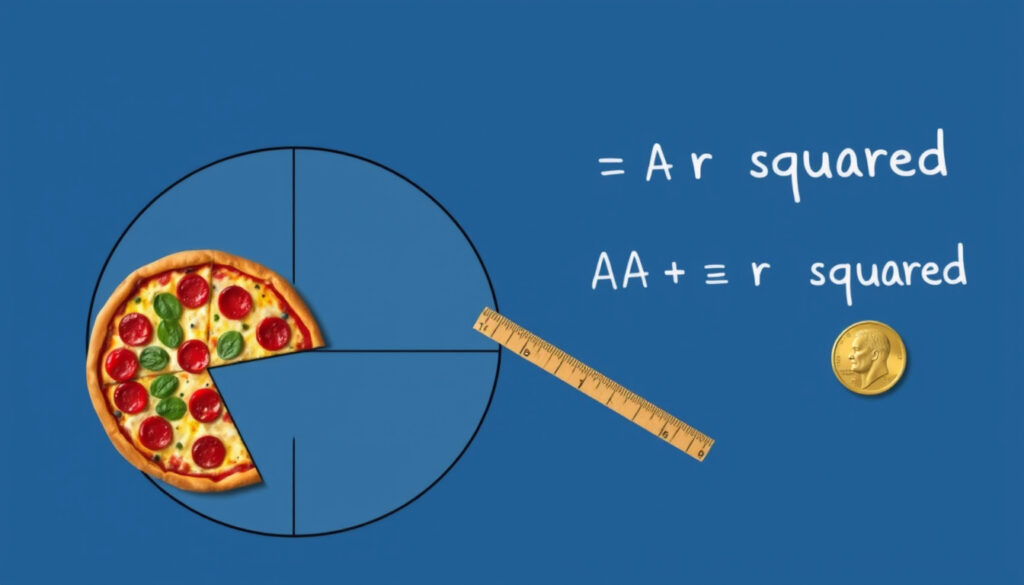
Few math formulas pop up as often—or cause as many mix‑ups—as the one for the area of a circle. Whether you’re a student tackling geometry homework or a DIYer measuring a round tabletop, the good news is that finding the area only takes one formula and a single measurement, and Khan Academy (trusted math education platform) puts it simply: the area of a circle is pi times the radius squared.
Formula for area of a circle: A = πr² ·
Value of Pi (π): approximately 3.14 ·
Common misconception: 2πr is circumference, not area ·
Example: radius 7 cm: Area ≈ 153.9 cm²
Quick snapshot
- A = πr² (Khan Academy)
- π ≈ 3.14 (commonly used approximation; Math for Kids)
- r = radius – distance from center to edge (Tutors.com)
- 3.14 is an approximation – π is irrational (Omni Calculator)
- π button gives more precise decimals (Mr. J’s tutorial)
- Square the radius first, then multiply by π (Third Space Learning)
- Confusing circumference (2πr) with area (πr²) – see Tutors.com
- Forgetting to square the radius (Third Space Learning)
- Using the diameter directly without halving (Tutors.com)
- Use parentheses: π × (r × r) (Omni Calculator)
- Check order of operations – square first (Khan Academy)
- Try online calculators for verification (Omni Calculator)
Three key facts tie the whole process together. One pattern emerges: whether you start with radius, diameter, or circumference, the area always depends on π and a squared length.
Here are the essential facts to keep at hand:
| Fact | Value | Source |
|---|---|---|
| Formula | A = πr² | Khan Academy |
| Pi approximation | 3.14 | Math for Kids |
| Area of 7 cm radius circle | 153.9 cm² | Omni Calculator |
How do you find the area of a circle?
To find the area of a circle, you need two things: the radius and the value of π. The radius is the distance from the center to the edge. Square the radius, then multiply by π. Third Space Learning outlines a three-step method: find the radius, apply A = πr², and state the answer with correct square units.
Understanding the formula A = πr²
The formula is compact but powerful. π is a constant, approximately 3.14, that relates circumference to diameter for every circle. Squaring the radius accounts for the two-dimensional spread.
What is the radius?
The radius is the straight-line distance from the center point to any point on the circle’s edge. If you have the diameter, halve it to get the radius.
Step-by-step calculation
- Measure or note the radius (r).
- Square the radius (r × r).
- Multiply by π (use 3.14 or the π button).
- Write the answer with square units (e.g., cm², m²).
The implication: once you grasp the two-step operation (square then multiply), the formula becomes automatic.
How to use 3.14 to find the area of a circle?
Many textbooks and tests use 3.14 as a practical approximation for π. It makes calculations easier with simple multiplication.
Why use 3.14 for Pi?
π is irrational, meaning its decimal never ends. 3.14 is close enough for most schoolwork and everyday measurements. Khan Academy uses it in many examples.
Example calculation with radius 5 cm
Area = 3.14 × (5 cm)² = 3.14 × 25 cm² = 78.5 cm².
Using calculator with π button vs 3.14
The π button gives more precise decimals (e.g., 3.14159…). For a radius of 5 cm, the π-button result is ≈78.5398 cm², while using 3.14 gives 78.5 cm². The difference is small for most purposes.
The catch: using 3.14 underestimates area by about 0.05% per calculation, which accumulates in large projects.
What is the area of a 7cm circle?
If the radius is exactly 7 cm, the area is π × 7² = 49π square centimeters.
Calculating area given radius 7 cm
Using 3.14: 3.14 × 49 = 153.86 cm². Using the π button: ≈153.93804 cm². Rounded to one decimal place, that’s 153.9 cm².
Result in square centimeters
The area is always expressed in square units. Since radius is in cm, the area is in cm².
Common rounding
Mr. J’s tutorial recommends rounding to the hundredths place unless otherwise specified. So 153.94 cm² is a common precise answer for 49π.
The pattern: the area scales with the square of the radius, so doubling the radius quadruples the area.
Is 3.14 the circumference?
No. 3.14 is an approximation of π, which appears in both area and circumference formulas, but it is not the circumference itself.
Difference between circumference and area
Circumference is the distance around the circle (2πr), while area is the space inside (πr²). Both use π, but they measure different things.
Formula 2πr vs πr²
2πr multiplies π by the diameter (2r), giving a linear measurement. πr² multiplies π by the square of the radius, giving a squared measurement.
Why both use Pi
π is the ratio of circumference to diameter, so it appears in any formula involving the circle’s size.
“The formula for the area of a circle is π × r².” – BBC Bitesize (KS3 Maths)
“The area of a regular polygon is half its perimeter multiplied by the distance from its center to its sides.” – Wikipedia (Area of a circle)
What this means: confusing the two formulas is the most common mistake – remember that area involves squaring, circumference does not.
How do you find the area of a circle with diameter?
If you only have the diameter (d), first divide by 2 to get the radius, then use the standard formula.
Converting diameter to radius
r = d / 2. Omni Calculator confirms: “If you know the diameter, divide it by 2 to find the radius.”
Using formula A = π(d/2)²
This is an alternative form: A = π × (d/2)² = πd²/4. It works identically.
Example with diameter 14 cm
Radius = 14 cm / 2 = 7 cm. Area = π × 7² = 49π ≈ 153.9 cm² – same as the previous example.
The takeaway: no matter what you start with – radius, diameter, or circumference – the area formula always reduces to π times a squared length.
For a detailed breakdown of the formula and more examples, see this guide on the area of a circle formula.
Frequently Asked Questions
What is the area of a circle with radius 10 cm?
Area = π × 10² = 100π ≈ 314 cm² (using 3.14) or 314.159 cm² with π button.
Can you calculate area if you only have the circumference?
Yes. Use C²/(4π). For example, if circumference is 44 cm, then radius = C/(2π) ≈ 7 cm, area ≈ 153.9 cm².
Why do we use Pi in the area formula?
Because π is the constant that relates a circle’s circumference (and area) to its radius. Without it, the formula wouldn’t be universal.
Is area measured in square units?
Absolutely. Area always uses squared units – cm², m², in² – because it measures two-dimensional space.
How to remember the difference between area and circumference?
Think: circumference is the “border” (linear), area is the “inside” (squared). The formula for area has a squared term (r²), circumference does not.
What happens if I use 3.14 instead of π button?
You get a slightly smaller result (0.05% less). For most homework it’s acceptable, but for precise engineering, use the π button.
More related posts
 High Potassium Foods to Avoid – Guide for CKD Patients
 Rainforest Wild ASIA: Tickets, Cave & Worth It? 2026 Guide
 Cast of It Chapter 1: Full Actors List & Characters
 Kim Choo Kueh Chang: History, Ownership, Storage, Buying Guide
 Singapore to Genting Highlands: Bus Time, Cost, How to Get
 Tea vs Coffee Benefits: Which Is Healthier? Science Data
 Kopi C Siew Dai: Meaning, Taste, and How to Order in Singapore
 Cast of Shang-Chi – Actors and Roles Guide
