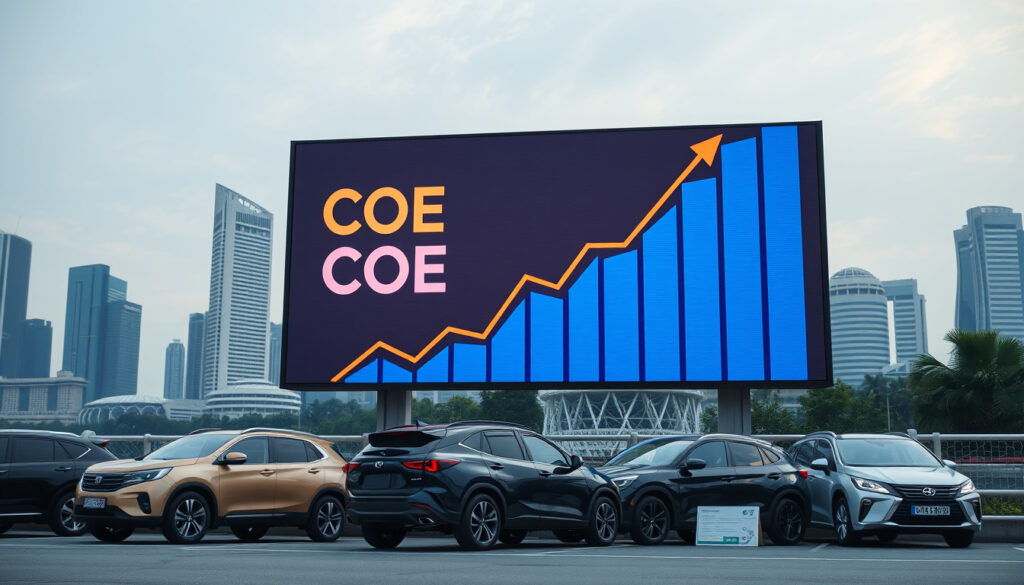
Singapore COE Prices Rise: Latest Results and Renewal Impact
For Singapore drivers watching their vehicle ownership costs spiral, April 2026 brought little comfort. The latest COE bidding exercise pushed Category A premiums to S$118,000, and this was the third consecutive round where every category climbed. Rising prices mean the 5-year versus 10-year renewal question that many owners have been putting off is now pressing—and the answer isn’t the same for everyone.
Category A COE: S$118,000 (up 5.5%) · Category B COE: S$121,000 · Category C COE: S$80,001 · Latest Bidding: April 2026 · Previous Cat A: S$111,890
Quick snapshot
- Cat A at S$118,000, up 5.5% from S$111,890 (Channel News Asia)
- Cat B at S$121,000, up 4.7% from S$115,568 (Straits Times coverage)
- Cat C at S$80,001 for commercial vehicles (Motorist bidding results)
- Third consecutive exercise with rises across all categories (Channel News Asia)
- Whether the upward trend will continue after April
- Exact impact of EV policies on future Category A/B premiums
- How petrol cars will fare beyond 2030 under new regulations
- October 2025: Cat A peaked at S$128,105
- February 2026: Cat B fell below Cat A, first since March 2020
- April 2026: Third consecutive all-category rise
- Next bidding round outcome depends on quota supply
- Owners nearing 10-year deregistration must decide on renewal
- PQP-based renewal costs will adjust monthly
| Label | Value |
|---|---|
| Highest COE Rise | Category A: 5.5% to S$118,000 |
| Bidding Date | April 8, 2026 (1st round) |
| Cat A Previous | S$111,890 |
| Cat A Quota | 1,265 with 2,537 bids received |
| Cat A PQP | S$107,407 |
| Cat B PQP | S$114,366 |
| Source Domains | Straits Times, SGCarmart, Channel News Asia |
Is it better to renew 5 or 10 years COE?
Singapore’s COE system forces vehicle owners into a decision once their current entitlement nears expiration. At the 10-year mark, owners face a binary choice that has financial consequences regardless of which path they take. A 5-year renewal costs 50% of the current Prevailing Quota Premium (PQP), while a 10-year renewal costs 100% of PQP (MoneySmart financial guide). In April 2026, that means Category A owners renewing for 5 years would pay around S$53,704, compared to S$107,407 for the full decade.
Costs of 5-year vs 10-year renewal
The math favors shorter renewals only when owners need to minimize upfront expenditure. A 5-year COE renewal spreads the cost over a shorter period and leaves options open for vehicle replacement sooner. However, the catch is that a 5-year renewal cannot be extended—it ends with mandatory deregistration (Leco automotive guide). For owners whose cars are already aging, this means the 5-year path is a final chapter, not a bridge to another renewal cycle.
Factors influencing choice amid rising prices
With COE prices climbing to S$118,000 for Category A in April 2026, the decision calculus has shifted. Banks offer loans up to S$20,000 for 5-year COE renewal over the loan period, which can ease cash flow pressure (MoneySmart loan information). However, owners must weigh this against the permanent forfeiture of any PARF (Preferential Additional Registration Fee) rebates when renewing. A 10-year renewal resets the COE cycle, allowing future renewals and preserving eligibility for PARF rebates—but only for those who can absorb the full S$107,407 Category A PQP hit upfront.
What is the 10 year car rule in Singapore?
Singapore’s vehicle deregistration framework operates on a hard 10-year cutoff for most passenger vehicles. After a car reaches its 10-year COE lifespan, owners must either renew the COE or deregister the vehicle entirely—no other options exist under the current system. The Land Transport Authority administers this rule through the official OneMotoring portal.
Details of the 10-year rule
When a vehicle’s COE expires, the owner has one month to either renew or deregister. Renewal options depend on the vehicle’s age and registration history. For vehicles approaching their 10-year mark, the PQP at the time of application determines renewal costs (ABLINK renewal guide). Category A covers cars with engine capacity up to 1,600cc or power output up to 130bhp or 110kW, while Category B applies to larger or more powerful vehicles (Motorist price data).
Consequences after 10 years
The system creates a hard boundary: cars without renewed COE must leave Singapore’s roads. Deregistration means the vehicle cannot be used and typically must be exported or scrapped. PARF rebates, which can offset deregistration costs for newer vehicles, are permanently forfeited upon COE renewal (Leco policy analysis). This penalty structure rewards newer vehicles and penalizes owners who delay renewal decisions.
Should you renew, sell or scrap your 10-15 year-old car?
For Singapore drivers holding vehicles between 10 and 15 years old, the current COE price surge presents a dilemma that cuts both ways. On one side, high COE premiums inflate the cost of keeping an older car on the road. On the other, the same premiums make older vehicles potentially more valuable as sale candidates—buyers inherit the existing COE without needing to bid fresh.
Pros and cons of each option
Renewing a 10-15 year-old car locks the owner into either S$53,704 (5-year) or S$107,407 (10-year) for Category A under current PQP. The vehicle’s market value at this age is typically lower than the renewal cost, which means owners are effectively paying a premium just to keep driving something depreciated. Selling transfers the problem: the buyer gets an existing COE with less time remaining, potentially at a discount to fresh bidding prices. Scrapping frees the owner from future costs but yields minimal salvage value.
Financial considerations with rising COE
The numbers tell a stark story. A 12-year-old Category A car might be worth S$40,000-S$60,000 in the used market, but a fresh 5-year COE renewal alone costs S$53,704 before considering the vehicle itself. Category B prices at S$121,000 in April 2026 make the math even tighter for owners of larger vehicles (Straits Times April 2026 coverage). Owners should calculate whether the vehicle’s remaining useful life justifies the renewal premium versus selling now while used car prices remain elevated.
Holding an aging car past 10 years means paying renewal costs that often exceed the vehicle’s worth. For most owners of 12-15 year-old cars, selling now while COE premiums support used car prices makes more financial sense than renewing and carrying the depreciation risk forward.
Will Singapore COE prices ever go down?
Historical data shows COE prices don’t move in only one direction, but the timing of dips is unpredictable. Category A reached S$128,105 in October 2025 before settling to S$108,220 in March 2026—a S$20,000 swing within six months. The April 2026 bidding pushed prices back up, demonstrating how quota supply and demand imbalances can reverse gains quickly.
Historical trends
February 2025 saw Category A at S$85,000, representing a significant trough before the upward movement through 2025 and into 2026. October 2024 started at S$103,799, and the all-time high for Category A hit S$119,003 in September 2025 before October 2025 exceeded it at S$128,105 (Motorist historical data). Category B prices fell below Category A in February 2026 for the first time since March 2020, showing that category-specific demand shifts create divergence patterns that buyers should monitor.
Factors influencing future prices
The PQP is calculated as a moving average of COE prices from the last three months, which means sudden spikes take time to fully feed into renewal costs (AAS PQP explanation). Quota supply adjustments by LTA based on vehicle population targets directly affect bidding competition. The government has signaled ongoing commitment to vehicle population controls, which suggests upward pressure on COE prices over the medium term, though monthly fluctuations will continue.
COE prices fluctuate monthly based on supply quota and bid competition, with PQP smoothing short-term volatility into renewal costs over three months. Owners should verify current PQP at the LTA OneMotoring portal before committing to any renewal decision—paying S$118,000 today doesn’t mean S$118,000 will be the renewal cost in three months.
What will happen to petrol cars after 2030 in Singapore?
Singapore’s vehicle electrification policies point toward a gradual phase-out of internal combustion engine vehicles, though the exact timeline and mechanisms for older petrol cars remain unclear. The government has not mandated retirement of existing petrol vehicles by 2030, but the regulatory environment increasingly favors electric alternatives.
Post-2030 regulations
Current policy incentives favor EV adoption through lower ARF (Additional Registration Fee) and import tax exemptions, but these apply to new vehicle registration, not existing petrol cars. No mandatory scrapping deadline exists for petrol vehicles registered before 2030. However, rising COE costs for any renewal—petrol or otherwise—effectively raise the cost of continued petrol vehicle ownership, creating economic pressure even without direct regulation.
Shift from petrol vehicles
The used EV market in Singapore remains nascent, with limited model availability and high initial costs. Category A COE now applies equally to EVs with smaller battery packs and lower power output, meaning electric car buyers face the same S$118,000 premium as petrol car buyers for equivalent-sized vehicles (SGCarmart price tracking). This creates a parallel cost structure that may accelerate the shift toward EVs once used EV prices become competitive with aging petrol alternatives.
Drivers holding petrol vehicles face a compound pressure: rising renewal costs alongside limited resale appeal as EVs capture more buyer interest in the 2030s.
| Renewal Option | Cost Basis | Cat A Cost (April 2026) | Key Limitation |
|---|---|---|---|
| 5-year renewal | 50% of PQP | S$53,704 | Non-extendable; vehicle must be deregistered after 5 years |
| 10-year renewal | 100% of PQP | S$107,407 | High upfront cost; resets COE cycle |
| Sell with existing COE | Market value | Varies by vehicle age | Buyer inherits remaining COE term |
| Deregister/ scrap | Scrap value | Minimal | No future ownership options; PARF rebate forfeited |
Upsides
- Selling now captures high used car prices before market correction
- 5-year renewal allows exit from ownership without full COE commitment
- 10-year renewal preserves flexibility for future renewals
- Newer vehicles qualify for PARF rebates upon deregistration
Downsides
- Renewal costs often exceed market value of 10-15 year-old vehicles
- PARF rebate permanently forfeited upon any renewal
- PQP changes monthly—renewal costs uncertain
- High upfront costs strain household budgets
What experts say
The Category A premium, which is for smaller cars, saw the largest percentage increase. Prices closed 5.5 per cent higher at S$118,000.
— Channel News Asia (news reporting on April 2026 results)
This is the third consecutive exercise in which premiums rose across all categories.
— The Straits Times (authoritative Singapore news coverage)
A five-year COE renewal has a lower upfront cost… However, once the five years are up, the COE cannot be renewed again.
— Leco Blog (automotive guide for Singapore drivers)
For Singapore drivers with aging vehicles, the April 2026 COE surge crystallizes a difficult reality: ownership costs have reached levels where the math often no longer works in favor of keeping older cars. The choice between 5-year and 10-year renewal isn’t just about money—it’s about whether the vehicle fits into your next decade of life or whether it’s time to let it go before renewal costs consume whatever value remains.
Related reading: Multi Storey Car Park · Royal Enfield Classic 350 Price
Amid rising COE prices and renewal debates, Singapore drivers must also navigate road tax obligations via the OneMotoring road tax renewal to stay compliant.
Frequently asked questions
What are the latest COE bidding results?
The April 8, 2026 bidding exercise closed with Category A at S$118,000 (up 5.5%), Category B at S$121,000, Category C at S$80,001, and Category E at S$121,001. This marked the third consecutive exercise where all categories saw price increases.
How does COE affect car ownership in Singapore?
COE is a quota license required to own a vehicle in Singapore, with premiums paid through competitive bidding. The COE cost is separate from the vehicle price, meaning owners effectively pay twice—once for the car and once for the right to keep it on the road for up to 10 years.
What is PQP COE?
PQP stands for Prevailing Quota Premium, which is the moving average of COE prices from the last three months. It serves as the basis for COE renewal costs: 5-year renewals cost 50% of PQP, while 10-year renewals cost 100% of PQP.
How to view COE price history?
The LTA OneMotoring portal publishes official COE open bidding results monthly. Third-party sites like Motorist and SGCarmart aggregate historical data back several years, allowing buyers to track trends across all categories.
Why do COE prices fluctuate?
COE prices fluctuate monthly based on the relationship between quota supply (determined by LTA vehicle population targets) and bid competition among buyers. Supply reductions or increased demand immediately affect prices in the next bidding round.
What factors drive COE price rises?
Vehicle population control policies, quotas limiting new registrations, overall economic conditions affecting car demand, and competition from commercial vehicle buyers all influence COE prices. The three-month PQP moving average smooths short-term volatility.
How often are COE bidding rounds held?
COE bidding takes place twice per month, typically in the first and second weeks. Results are published on the LTA OneMotoring website, with the Prevailing Quota Premium updated monthly based on the preceding three months’ average prices.
More related posts
 SME Working Capital Loan: Rates, Eligibility, and How to Apply
 Flights to Shanghai from Singapore: Duration, Airlines & Tips
 Shruthi Narayanan Viral Video: What Happened and Her Response
 Junior Colleges in Singapore: List and Cut-Off Points (2025)
 EVA Air Flight Attendant Death: Cause and Investigation
 How to Stop Overthinking: Effective Techniques and Insights
 Japan Flight from Singapore: Time, Distance & Cheap Months
 Watch Shop Far East Plaza: Luxury, Pre-Owned, Ladies & More
