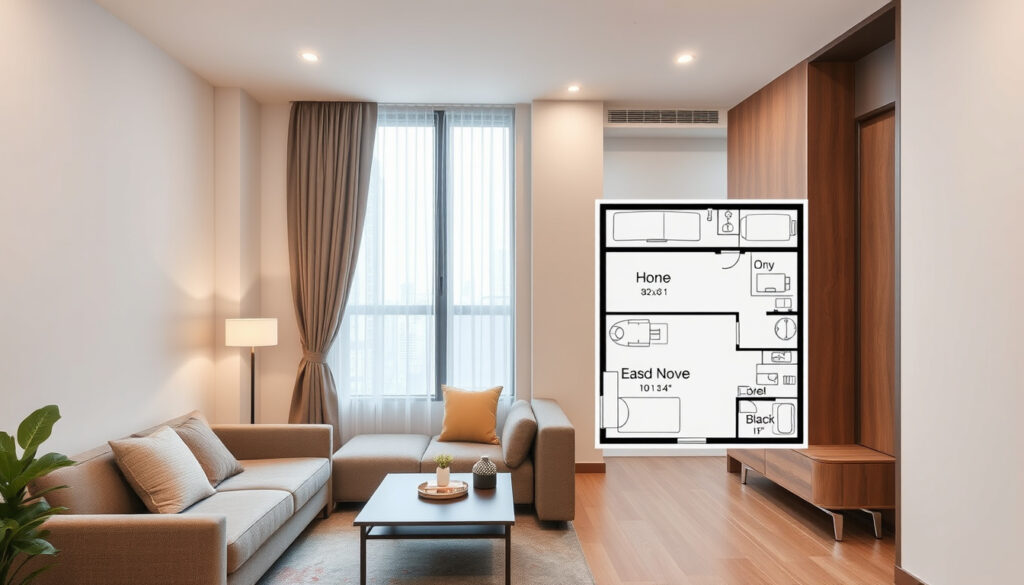
Singapore Home Sizes Decrease: Why Houses Are Getting Smaller
Anyone who’s looked at a new condo showroom lately might have noticed things feel a bit more, well, compact. It’s not your imagination: Singapore homes have been shrinking for decades, and the trend has real implications for buyers, investors, and families.
Average household size (1980): 4.87 · Average household size (2025): 3.06 · Median new condo size (2010): 1,012 sq ft · Median new condo size (2024): 904 sq ft · Decline in median condo size since 2010: 10.6%
Quick snapshot
- Average household size dropped from 4.87 (1980) to 3.06 (2025) (The Straits Times)
- Median new condo size fell 10.6% from 2010 to 2024 (The Straits Times)
- Whether home sizes will continue shrinking or stabilize is uncertain
- Exact timeline for future HDB lease top-up policies remains unclear
- 1980: Household size 4.87 — 2025: 3.06; steady decline across four decades (The Straits Times)
- More small-format units expected as developers target price-sensitive buyers (The Straits Times)
Five key facts, one pattern: every metric points in the same direction — Singaporeans are living in smaller spaces with fewer people, and the housing stock is adapting to that new reality.
| Metric | Value |
|---|---|
| Current average household size (2025) | 3.06 persons |
| Median new condo size (2024) | 904 sq ft |
| Median new condo size (2010) | 1,012 sq ft |
| HDB lease term | 99 years |
| Source of household size data | Singapore Department of Statistics |
Why Are Houses in Singapore Getting Smaller?
Demographic shifts and smaller households
The biggest driver of shrinking home sizes isn’t greedy developers — it’s demographics. Singapore’s average resident household size has been falling consistently since 1968, according to the HDB Sample Household Survey 2023/24 Monograph. Fewer children per family, more singles, and a rise in dual-income-no-kids (DINK) couples mean households simply need less space.
- Average household size fell from 4.87 in 1980 to 4.0 in 1995, then 3.6 in 2005, 3.4 in 2015, 3.1 in 2024, reaching 3.06 in 2025 (The Straits Times).
- One-person households made up 16% of all resident households in 2025 (The Straits Times).
What this means: when the average household drops from nearly five people to just over three, demand for four-bedroom units naturally recedes. Builders are simply following the buyer profile.
Policy encouraging small-format housing
Government policy has also nudged the market toward smaller units. The Housing & Development Board (HDB) — which provides homes for about 80% of Singapore’s resident population — has introduced smaller flat types over the years, such as 2-room Flexi flats designed for singles and elderly households. Meanwhile, on the private market, developers responded by launching more compact units, especially between 2014 and 2018, when small-format homes became particularly popular with investors. The Business Times reported that average HDB household size shrank from 3.1 persons in 2018 to 3.0 in 2023/2024, confirming the trend extends across both public and private housing.
Smaller units mean lower absolute prices, which helps first-time buyers and investors enter the market. But they also mean less living space per person — a trade-off that families with children feel most acutely.
Market preference for lower absolute prices
Buyers, particularly investors, have shown a clear preference for units with smaller price tags. A 904 sq ft condo in 2024 costs less in absolute dollars than a 1,012 sq ft unit from 2010 — even if the per-square-foot price has risen. This dynamic pushes developers to slice units into smaller portions to keep total prices attractive. According to The Straits Times, the median size of new non-landed condos dropped 10.6% between 2010 and 2024, a trend most pronounced in prime districts where median size fell from 1,044 sq ft to 829 sq ft — a 20.6% decline, as noted by Yahoo News Singapore.
What Is the Average Household Size in Singapore?
Current figure and historical trend
As of 2025, the average resident household size in Singapore stands at 3.06 persons, according to The Straits Times citing Singapore Department of Statistics data. That figure has been on a near-linear decline for decades.
- 1980: 4.87 persons
- 1995: 4.0 persons
- 2005: 3.6 persons
- 2015: 3.4 persons
- 2024: 3.1 persons
- 2025: 3.06 persons
Sources: The Straits Times and HDB Sample Household Survey 2023/24
The implication: the decline is consistent across four decades, with no sign of reversal.
Comparison to other countries
How does Singapore compare to its peers? Data from the United Nations and OECD show that developed Asian economies generally have smaller household sizes than Western nations, but Singapore’s 3.06 is notably low even by regional standards. Japan’s average household size is around 2.3, while South Korea sits at about 2.4. Among Southeast Asian peers, Malaysia’s average household size is approximately 4.0, and Thailand’s is about 3.1, placing Singapore at the lower end of the spectrum. The implication: smaller homes aren’t just a local anomaly — they reflect a structural shift in who lives in them.
While smaller household sizes reduce demand for space, they also concentrate housing costs on fewer shoulders. A single person or DINK couple may want a smaller home, but they’re still paying for the full cost of that unit — including land and common facilities — without splitting it across four or five incomes.
Will My HDB Flat Be Worth $0 After 99 Years?
What happens when the lease expires
HDB flats are sold on 99-year leases, and when the lease runs out, ownership reverts to the state. That much is fixed. The question is whether the flat’s resale value drops to zero before that point. According to HDB, lease decay is real: as the remaining lease shortens, the value of the property declines, particularly after the 50-60 year mark. However, “worth $0 at expiry” is not the same as “worth $0 at year 70” — many flats retain residual value tied to their location and potential for redevelopment.
- HDB flats have 99-year leases that revert to the state at expiry
- Value declines as lease shortens, but not necessarily to zero before expiry
- The government may offer lease top-up schemes, but policies remain unclear for the long term
The pattern: leasehold value isn’t a cliff you fall off at year 99 — it’s a gradual slope that steepens the closer you get.
Factors influencing resale value over time
Location matters enormously. A flat in a mature estate near an MRT station and a popular school will hold its value better than one in a less connected area, even as the lease ticks down. The Business Times notes that the government has introduced policies like the Voluntary Early Redevelopment Scheme (VERS) and Lease Buyback Scheme to help older leaseholders, but these don’t eliminate the core reality: a 99-year lease is a depreciating asset.
For a 30-year-old buying a new HDB flat today, that lease will have about 65 years left at retirement. The flat may still have value, but it will be a different asset than the one they bought — and that changes the calculus for anyone using their home as a retirement nest egg.
Pros and Cons of Buying Property in Singapore Now
Upsides
- Prices have risen post-pandemic, which means existing owners have seen appreciation (The Straits Times)
- Cooling measures like ABSD and TDSR have slowed speculative buying, potentially creating more stable market conditions for genuine buyers
- Smaller units mean lower absolute prices, making entry more accessible for first-time buyers
Downsides
- Higher interest rates have reduced affordability for leveraged buyers
- Leasehold value erosion means long-term holding strategies need careful planning
- Cooling measures like Additional Buyer’s Stamp Duty (ABSD) can add significant costs for investors and foreign buyers
The trade-off: buying now gets you into the market, but with smaller units and higher financing costs than a decade ago. For owner-occupiers, the decision is about lifestyle timing; for investors, it’s about yield versus lease decay.
Timeline: The Shrinking Home in Singapore
- 1980 — Average household size 4.87; large families prevalent
- 1995 — Average household size 4.0; decline underway
- 2005 — Average household size 3.6
- 2010 — Median new condo size hits 1,012 sq ft; average household size 3.5
- 2014–2018 — Small-format homes surge in popularity; average home sizes drop noticeably
- 2024 — Median new condo size 904 sq ft; average household size 3.1
- 2025 — Average household size 3.06; 16% of households are single-person
Sources: The Straits Times, HDB Sample Household Survey
Confirmed Facts vs. What’s Unclear
Confirmed facts
- Average household size declined from 4.87 in 1980 to 3.06 in 2025 (The Straits Times)
- Median new condo size dropped 10.6% from 2010 to 2024 (The Straits Times)
- Average HDB household size fell from 3.1 in 2018 to 3.0 in 2023/2024 (The Business Times)
- One-person households now represent 16% of all resident households (The Straits Times)
What’s unclear
- Whether home sizes will continue shrinking or stabilize as demographics shift further
- The exact timeline for HDB lease top-up policies, which could affect long-term value of aging flats
“You’re not imagining it: Singapore homes are getting smaller.”
— The Straits Times
Singapore’s housing story is one of adaptation: smaller families, smaller units, and a market that’s learning to fit more people into less space. For the average buyer, the decision isn’t just about square footage — it’s about understanding that a home is both a place to live and a financial asset with a defined lifespan. For the young family looking at a 3-room HDB flat, the choice is clear: get in early and plan for the lease, or wait and face even smaller options at higher per-square-foot prices.
Related reading: **Storage Bed Frame Singapore: Types & Prices Compared**
propertyguru.com.sg, blog.maxthon.com, sg.finance.yahoo.com, rea-global.com, 99.co, businesstimes.com.sg, youtube.com
Frequently Asked Questions
What is the average square footage of a new HDB flat?
Typical new 4-room HDB flats range from about 850 to 950 sq ft, while 5-room flats are around 1,000 to 1,100 sq ft. Exact sizes vary by project.
How does Singapore’s household size compare to other developed countries?
Singapore’s 3.06 is lower than most Southeast Asian peers (Malaysia ~4.0, Thailand ~3.1) but higher than Japan (~2.3) and South Korea (~2.4).
Are HDB flats smaller than they were 20 years ago?
Yes. Average HDB household size has shrunk from 3.6 in 2005 to 3.0 in 2023/2024, and flat designs have been adjusted to match smaller household needs.
What factors cause home sizes to shrink?
The main drivers are demographic change (smaller families, more singles), policy (smaller flat types from HDB), and market forces (lower absolute prices attract buyers).
Does a 99-year lease mean the property is worthless at year 99?
Not exactly. The property’s value declines as the lease shortens, but it doesn’t necessarily reach zero before expiry. Location and potential for redevelopment influence residual value.
Is buying a freehold property in Singapore better than leasehold?
Freehold properties have no expiry and may appreciate differently, but they cost more upfront. Leasehold (99-year) remains the standard for HDB and most condos, and can still be a sound investment if bought at the right price.
What are the current cooling measures for property buyers in Singapore?
Key measures include Additional Buyer’s Stamp Duty (ABSD), Total Debt Servicing Ratio (TDSR) limits, and Loan-to-Value (LTV) restrictions. These affect how much buyers can borrow and how much tax they pay on additional properties.
More related posts
 How to Learn Fa ter and Better: 6 Science-Backed Method
 URA HDB Singapore Land Sales: Government Land Sales Guide
 One Prawn and Co Reviews: What Diners Say About New Bahru
 iPhone Trade In Singapore: Apple vs Mister Mobile Prices
 Part Time Retail Jobs in Ireland: Dublin, Students, No Experience
 Jacky Cheung Concert 2025: Singapore & KL Dates, Tickets
 Redmi Note 14 Pro 5G: Specs, Review, Price & Verdict
 Standard Chartered Near Me: Find Branches, ATMs, Compare HSBC
